“Dad. You’re Embarrassing Us.” — When My Son’s Bride Shoved My Wife Into the Mud in Front of Two Hundred Guests, I Walked to the Microphone and Said Something That Silenced the Entire Garden
Chapter 1
“Dad. You’re Embarrassing Us.” — When my son said those words to me, I was standing at the microphone in front of two hundred wedding guests, the band silent, the string lights swaying above a garden that had promised celebration and delivered something much harder instead.
My wife Margaret sat at the edge of the lawn in my jacket, mud still darkening her pale blue dress from shoulder to knee, her silver hair undone at one side, her hands trembling but her face steady in the way faces go steady when dignity has been stripped in public and the only thing left is deciding who you are going to be in the next sixty seconds.
For months she had tried to love Vanessa. She helped choose flowers. She addressed invitations by hand at the kitchen table in her careful script. She gave Vanessa the pearl bracelet her own mother had worn on her wedding day, pressing it into her hands with the particular tenderness of a woman offering something she cannot replace. Vanessa accepted it with a smile and later told her bridesmaids, loud enough for Margaret to hear, that it was vintage she supposed — that maybe she would wear it for the rehearsal but not the actual wedding. Margaret said nothing. That was her way.
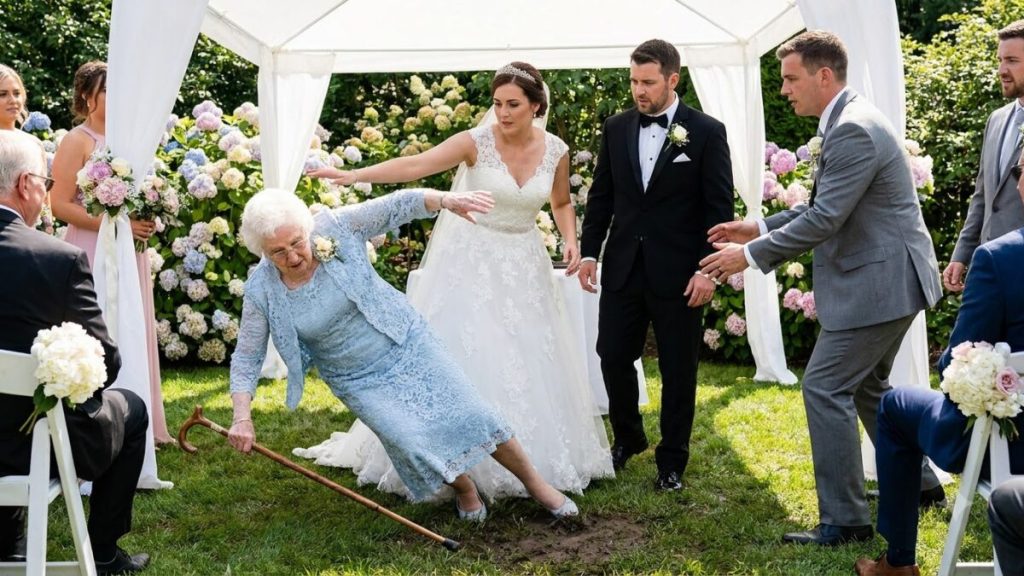
The ceremony ended beautifully. Vows were spoken, the kiss came, champagne was poured, and the band began soft jazz as two hundred people filtered across manicured grass toward white-draped tables and string lights and the warm particular happiness of a celebration that believes itself to be going well. Then, near the edge of the lawn where rain from the night before had softened the ground, Vanessa came up behind Margaret with two bridesmaids at her side. I watched from across the grass without yet understanding what I was seeing. Vanessa leaned close and said something. Margaret turned, confused. Then Vanessa placed both hands on my wife’s shoulders and shoved.
Margaret fell sideways into the mud. Her handkerchief landed in a puddle. Her cane rolled away. For one terrible second, two hundred people went completely silent. Then Vanessa laughed — not nervously, not in the startled way of someone who has made a terrible mistake, but like a person who had finally done something she had been waiting to do and found it exactly as satisfying as she imagined. Daniel stepped toward her. I expected him to go to his mother. Instead, my son put his arm around Vanessa’s waist, leaned close to her ear, and whispered something. Vanessa laughed harder.
Something inside me became very calm. Not the hot calm of rage being suppressed — the cold calm of a man who has just understood something completely. I picked up Margaret’s cane. I helped her stand. I gave her my jacket. Then I walked to the microphone near the bandstand and tapped it once. The sound cracked across the garden. Every face turned. I looked at my son first. Then at his bride. Then at two hundred people who had just watched my wife pushed into the mud at her own son’s wedding and not one of whom had moved to help her.
“Ladies and gentlemen,” I said, “before the first dance, I believe everyone here deserves to understand why this wedding will not be paid for by the Whitmore family.”
For three seconds, no one moved. The string lights swayed in the evening breeze. Somewhere behind the tent, a caterer dropped a tray. Daniel’s smile disappeared.
What happened next is the reason people are still talking about this story today.
Chapter 2
The Sound of Two Hundred People Going Silent
That night divided my life into before and after — before I understood what my son had become, and after I decided what I would no longer pay for. The wedding was held at Briarwood Estate, a white-columned venue outside Charleston with manicured lawns that rolled down to a still lake behind the ceremony arch, and two hundred guests dressed as though they had stepped from the pages of a magazine, their perfume and cologne mixing with the salt air drifting in from the coast.
My son Daniel stood beside his bride Vanessa smiling like a man who had just won everything he had ever wanted, and my wife Margaret sat in the front row with tears in her eyes and a folded handkerchief in both hands, the way she always sat at moments she wanted to hold carefully — her fingers steady, her breathing deliberate, her pale blue dress pressed and perfect for an occasion she had spent months believing in.
Popular Posts
→- 1
- 2
- 3
- 4




Recently Viewed
Stories you read recently will appear here.





