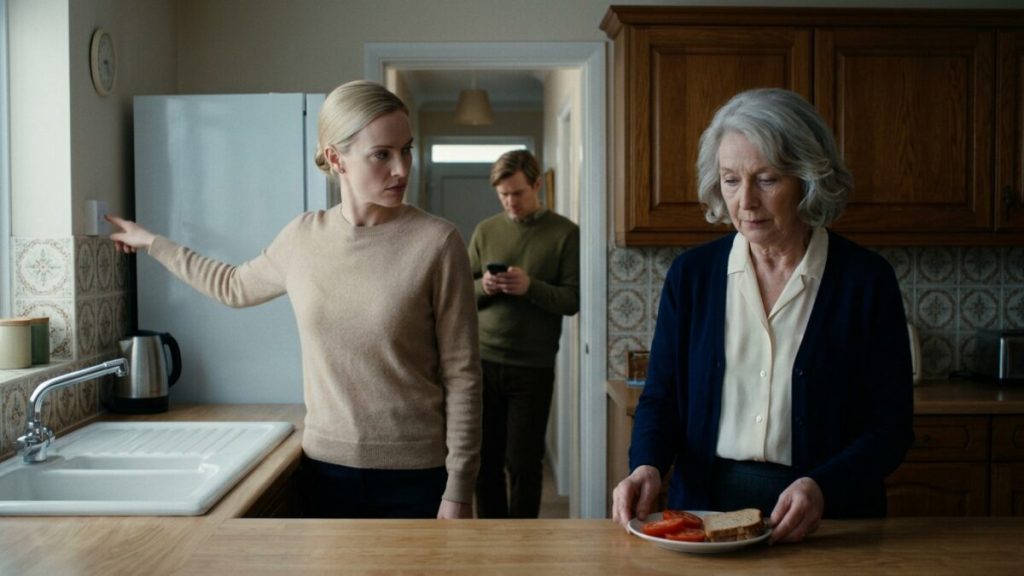
I was preparing dinner in my own kitchen when my daughter-in-law switched off the light and told me: go eat in your room. We’re having a private dinner. My son turned his eyes away. I lifted my plate and left. The next morning… I made one phone call.
My Daughter-in-Law Ordered Me to Eat in My Room, So the Following Morning I Made One Phone Call
The kitchen fell dark while my hands were still damp from rinsing tomatoes in the sink.
For a moment, I thought the lightbulb had gone out. Then I turned around and saw Kristen beside the switch, her fingers still touching it, her expression composed in that polished way people use when they want cruelty to pass for politeness.
Preview
“We’d rather you eat in your room tonight, Margaret,” she said. “We’re having a private dinner.”
I was standing at my own counter.
Not a counter in a rental. Not a counter inside my son’s home. Not a counter I had been allowed to use for a temporary stretch of my life and would eventually have to give back.
My counter.
Pale birchwood veneer, restored by my own two hands on a blistering July weekend nearly twenty years earlier, when my husband was still alive and our son Daniel was still young enough to grumble about the odor of varnish. I had picked it after three separate trips to the hardware store. I had sanded the corners myself. I had stood in that exact place making school lunches, Thanksgiving dressing, birthday cakes, funeral casseroles, and cups of hot tea on nights when sorrow made sleep impossible.
And now my daughter-in-law had shut off the light in my kitchen and told me to carry my plate to my room.
I looked beyond her into the living room.
My son was standing in the doorway.
Daniel had one hand tucked in his pocket and the other wrapped around his phone. He did not seem angry. He did not seem embarrassed either. He just looked exhausted. It was the expression he had developed whenever life demanded that he choose between comfort and courage.
He looked away.
Preview
That wounded me more deeply than Kristen’s words.
I had a tomato in my hand. A red beefsteak tomato from the raised garden bed behind the garage, still holding the warmth of the August sun even after I had washed it beneath the tap. I placed it carefully on the cutting board. I set the knife down beside it. I lifted the small plate I had already prepared for myself, a slice of toast, sliced tomato, a little cheese, nothing that could have possibly bothered anyone, and I walked out of my own kitchen.
No speech.
No tears.
No cupboard slammed shut.
Only the sound of my slippers brushing along the hallway floor and my son saying absolutely nothing behind me.
My bedroom sat at the rear of the house,
down the short hall past the laundry closet. I sat on the edge of my bed in the darkness, holding that plate in my lap like a child being sent away from a family gathering as punishment.
From the kitchen, I heard Kristen switch the light back on.
A few minutes later, the front door opened. Her colleague had arrived. Laughter followed, the smooth kind people use when they are trying to impress someone. Glasses chimed. My granddaughter Lily squealed at something. Daniel said, “Come on in, good to see you.”
Then the smell of garlic and butter drifted from the kitchen.
My kitchen.
I did not eat the toast. I stayed there until the tomatoes on my plate softened at the edges and the room became darker than the hallway.
That was the night I finally allowed myself to admit something had gone terribly wrong.
Not only with them.
With me.
Preview
My name is Margaret Ellis. I am sixty-seven years old, and for most of my grown life, I would have called myself sensible.
Not dramatic. Not helpless. Not the kind of woman who lets people step all over her and then wonders where her dignity disappeared to.
I taught fourth grade for thirty-one years in the public school system. I could silence a classroom of twenty-eight restless children with a single look. I could recognize a forged parent signature from the other side of a desk.
I could tell when a little boy said his stomach hurt because he was truly ill, and when he said it because someone had been teasing him about his shoes during recess.
I raised Daniel mostly alone after my husband, Peter, became sick.
I dealt with doctors, bills, winter tires, parent-teacher meetings, leaking gutters, and the slow, punishing loneliness of losing the person you had expected to grow old beside.
I owned my house completely.
That was the part I kept repeating to myself, as though saying it enough times might make me feel less like a visitor.
Popular Posts
→- 1
- 2
- 3
- 4




Recently Viewed
Stories you read recently will appear here.





