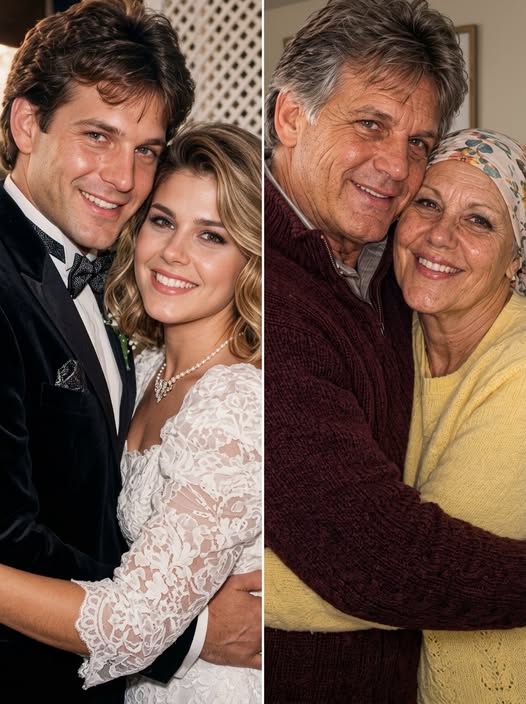
My wife, Doreen, and I had been married for thirty-six years when the doctor told us her cancer had spread too far for treatment to help anymore. He spoke carefully, pausing between sentences as if softer words might somehow make the truth easier to hear, but there was only one thing I understood clearly.
We were running out of time.
During the final week of her life, I barely left her hospital room. I slept in the chair beside her bed, ate whatever our daughter brought from the cafeteria, and spent hours holding Doreen’s hand while the machines around us filled the silence with their steady sounds.
One evening, after sleeping most of the afternoon, she opened her eyes and looked at me.
“Russell, I need you to promise me something.”
I moved closer to the bed and took her hand between both of mine.
“Anything, Doreen. You know that.”
Her expression changed then. There was fear in her eyes, but also something else I couldn’t understand at the time.
“Find Sylvia,” she whispered. “Please find her.”
For several seconds, I honestly believed I had misheard her.
“Sylvia?”
Doreen nodded slowly.
“You’ll understand once you find her. And when you do, please try to forgive me.”
I stared at my wife, completely confused.
Sylvia had been my first love.
I hadn’t seen her in almost forty years.
“Doreen, what are you talking about? Why would I need to find Sylvia? What am I supposed to forgive you for?”
She closed her eyes and shook her head.
“I can’t explain it properly anymore. Just promise me you’ll look for her.”
Before I could question her further, a nurse came in and gently reminded me that Doreen needed to rest. I told myself there would be another opportunity to ask.
There wasn’t.
Three days later, my wife died.
For the first few weeks, grief swallowed everything else.
The house felt strangely empty, even though nothing in it had changed. Doreen’s slippers were still beside the bed. Her reading glasses were still on the kitchen counter, next to a half-finished crossword puzzle. A grocery list remained attached to the refrigerator with a magnet.
Milk. Apples. Coffee.
Ordinary things written by someone who had expected to be alive long enough to need them.
Our daughter, Taryn, came over almost every day. She was thirty-seven, married, and had two children of her own, but she still worried about me the way Doreen always had.
“Dad, come stay with us for a while. You shouldn’t be alone here.”
I kept telling her I was fine, though neither of us believed it.
As painful as losing Doreen was, one thing refused to leave my mind.
Find Sylvia.
Please forgive me.
Eventually, I realized that if I ignored Doreen’s final wish, I would spend the rest of my life wondering what she had been trying to tell me.
Sylvia and I had met in college when we were both twenty.
She was studying education, and I was finishing an engineering degree. We were young enough to believe love could solve almost anything, and for a while, I thought it would.
During our final year, I proposed.
Sylvia said yes.
Then I received a job offer three states away. It was a good opportunity, and I assumed we would move together once we married.
Instead, two weeks before I was supposed to leave, Sylvia sent me a letter.
She told me she couldn’t follow me.
She said she wasn’t ready to leave her family and asked me not to come looking for her.
I was devastated.
For months afterward, I went through every conversation we’d ever had, trying to understand how a woman who had promised to marry me could suddenly decide she no longer wanted the future we’d planned.
About a year later, I met Doreen through my mother.
Doreen knew I had been hurt before, but she never pushed me to talk about Sylvia. She simply stayed close enough that, over time, my life stopped feeling like it had ended.
Eventually, I fell in love with her.
Doreen told me early in our relationship that she couldn’t have children. I accepted it without hesitation, and a few years after we married, she suggested adoption.
That was how Taryn came into our lives.
She was only six weeks old when we brought her home.
I still remembered standing beside her crib that first night, terrified by how tiny she was. Doreen had slipped her arm through mine and whispered, “She’s ours now.”
And she had been ours in every way that mattered.
Birthday parties.
School plays.
Broken bones.
Teenage arguments.
College graduation.
Her wedding.
Then our grandchildren.
Never once had I considered Taryn anything other than my daughter.
About three weeks after Doreen’s funeral, I began searching for Sylvia.
It wasn’t easy.
Eventually, an old college friend gave me the married name of Sylvia’s sister. One call led to another until I finally got a phone number.
I stared at it for nearly an hour before dialing.
A woman answered.
“Hello?”
Even after almost four decades, I recognized her voice.
“Sylvia?”
There was a long silence.
“Russell?”
We spoke awkwardly for a few minutes before I finally told her why I had called.
“Doreen died a few weeks ago.”
“I’m sorry,” Sylvia said quietly.
“Before she died, she asked me to find you.”
Another silence followed.
This one felt heavier.
“Did she?”
“Yes. She said I’d understand everything once I found you.”
Sylvia took a slow breath.
Then she gave me her address.
“Come Saturday. I think this is something we should discuss in person.”
The drive took nearly four hours.
When I finally reached her house, I sat in the car for almost forty minutes, asking myself what kind of man visited his first love so soon after burying his wife.
Eventually, I forced myself to knock.
Sylvia opened the door.
Popular Posts
→- 1
- 2
- 3
- 4




Recently Viewed
Stories you read recently will appear here.





