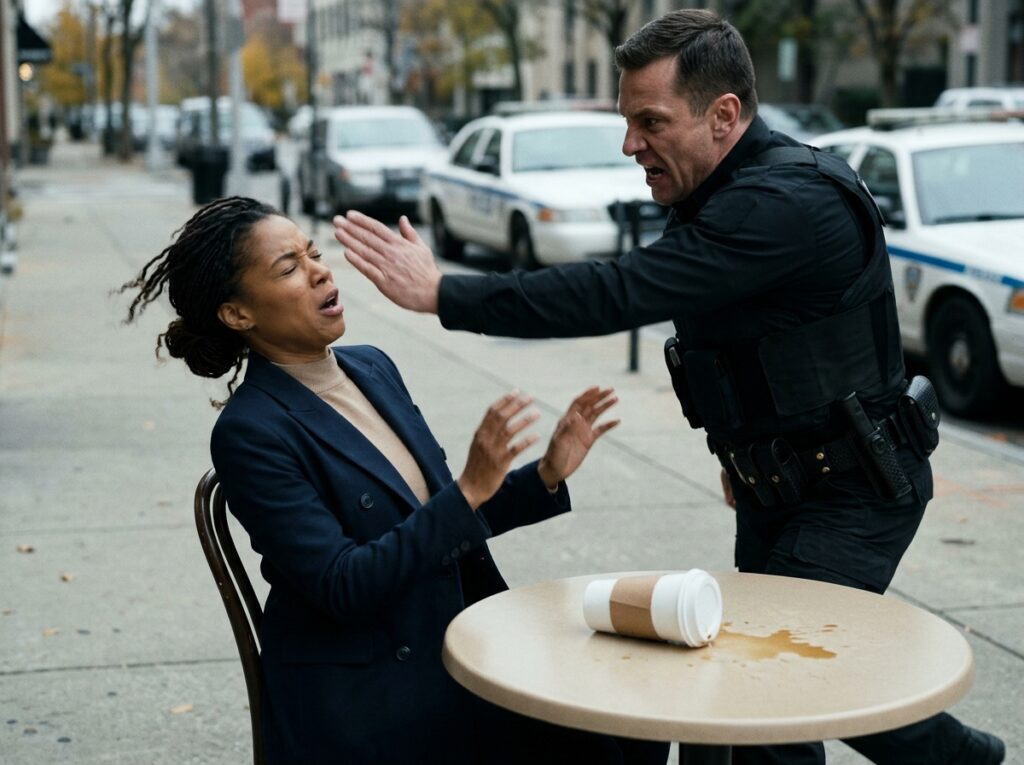
Cop Arrested a Black Woman for Drinking Coffee — He Had No Idea She Was a Top FBI Official!.
You’re under arrest for drinking coffee. That badge says FBI. Big mistake, officer. Huh? You know what, sweetheart?
I’ve been doing this job for 9 years, and I have never once seen a black woman sitting alone in this neighborhood at 8:00 in the morning in a blazer like that without a very good reason to be nervous. He said it loud enough for the whole cafe to hear. Then he reached into her jacket, pulled out her badge. Wallet looked at it for exactly three seconds and dropped it into the puddle of spilled coffee on the counter like it was a receipt he didn’t want touching his fingers. Nice prop.
Where’d you order it? Amazon five-star reviews. A few people looked away. Nobody said anything. He wasn’t finished.
He leaned down until his face was level with hers and said quietly enough to feel like a threat, “Here’s what’s going to happen. You’re going to stand up, put your hands behind your back, and stop embarrassing yourself because whatever story you’ve got prepared, nobody in this room is going to believe it over me.” She did not move. She did not raise her voice. She looked at the security camera above the chalkboard menu and said nothing. Then, as he snapped the first cuff onto her wrist in front of a cafe full of witnesses, she looked directly into that lens one more time, like she had been waiting for exactly this moment her entire career.
What officer Kyle Brandt did not know what would cost him everything 61 days later in a federal courtroom was that the small silver pin on the lapel of her blazer had been recording since 7:41 that morning. Every word, every sneer, crystal clear, encrypted, intact. Hey everyone, every week I find one story from somewhere in America that stopped me cold. Tonight, it’s this one. What’s up everyone?
I travel this country looking for the moments that remind us who we really are. Pull up a chair. There are people who walk into a room and immediately change its temperature. Not because they are loud, not because they demand attention, but because something in the way they carry themselves. The set of the shoulders, the quality of the stillness, the eyes that move across a space and miss nothing communicate something that cannot be faked and cannot be taught.
It is the product of years, decades of rooms that tried to break them and didn’t. Special agent Renee Caldwell was that kind of person. At 48 years old, she was the deputy assistant director of the Federal Bureau of Investigations Civil Rights Division, one of only seven people in the country who held that title, and the only black woman among them. She had not arrived at that position through connections or circumstance. She had arrived there the way she arrived at everything methodically, precisely, and at a cost.
She had paid herself in full, without asking anyone to share the bill. Her record spoke in numbers that did not require commentary. In 2019, she led the 18-month undercover operation that dismantled a police corruption ring in Detroit. 14 officers, two supervisors, and a deputy commissioner, all indicted on the same Tuesday morning before any of them had the chance to coordinate a story. In 2021, she coordinated the prosecution of a sitting county judge in Savannah who had been accepting bribes from a private prison contractor for 6 years.
The judge had believed until the morning of his arrest that he was untouchable. He had been wrong about that in the specific irreversible way that people are wrong when Renee Caldwell has spent a year building a case against them. She had testified four times before the Senate Judiciary Committee twice under questioning that had been specifically engineered to rattle her, to make her contradict herself, to make her angry, and she had not given them a single word they could use. Not once, not ever. She was by any reasonable measure one of the most accomplished federal law enforcement officers in the country.
On the morning of October 14th, what she wanted with an urgency that was almost ordinary given the weight of her usual concerns was a decent cup of coffee and 20 minutes of quiet before a breakfast meeting. She pulled her black government-issued Tahoe to the curb on Chestnut Street at 7:43 a.m. and cut the engine through the windshield. Maplewood, Ohio, looked exactly as it always looked, deliberate, manicured, aggressively pleasant. The kind of suburb where the sidewalks were pressure washed every spring, the flower beds outside the bank rotated with the seasons, and the trees lining the main street had been trimmed to a uniformity that suggested someone had once consulted a diagram. The oaks along Chestnut had just begun their October turn leaves going amber at the edges, and the morning air carried that particular smell cool and faintly sweet, like something ending with good manners.
Popular Posts
→- 1
- 2
- 3
- 4




Recently Viewed
Stories you read recently will appear here.





