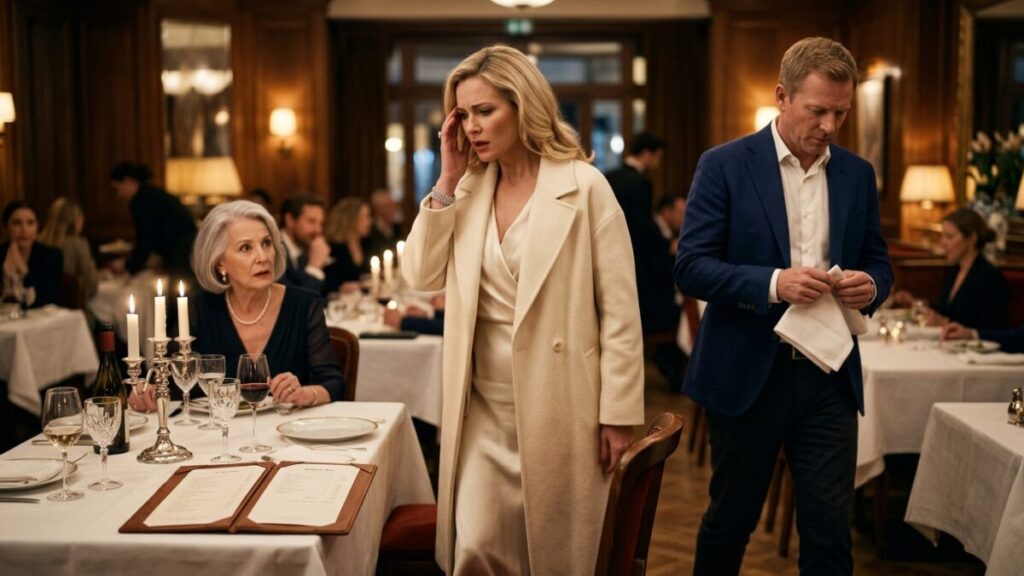
My son and his wife abandoned me at a Sacramento steakhouse with a $942 bill and two empty chairs, thinking a seventy-five-year-old widow would be too embarrassed to make a scene—so I smiled at the waiter, ordered black coffee, took one photo of their untouched napkins, and made a call that turned their entire house quiet by Wednesday.
The waiter brought the check in a small black leather folder and placed it on the white tablecloth between two empty chairs.
One chair had belonged to my son.
The other had belonged to his wife.
In front of me sat a half-finished glass of Pinot Noir, my reading glasses, and the kind of silence that only comes after someone has done something cruel and expected you to be too polite to name it.
For a few seconds, I simply looked at the folder.
Then I looked at the chairs.
Then I looked toward the front of the restaurant, where Donovan and Phaedra had walked out fourteen minutes earlier under the soft, convenient excuse that Phaedra had developed a migraine and needed to get home to the children.
“Mom, you stay,” Donovan had said, standing with his hand already on the back of Phaedra’s chair. “Finish your wine. Take your time.”
Phaedra had touched her temple with two fingers, her diamond bracelet catching the light.
“I hate to leave you like this, Camille,” she had said, in that smooth country-club voice she used when she wanted cruelty to sound like manners. “But I’m just suddenly not feeling well.”
The children had already been gathered up, their little jackets pulled over their shoulders. Caspian had chocolate on his sleeve. Theodora was carrying the small paper bag of leftover pastries the waiter had packed for her.
I had smiled.
Of course I had smiled.
For years, smiling had been the tax I paid to remain invited.
“Of course, sweetheart,” I said. “You go on. I’ll be fine.”
Donovan leaned down and kissed the top of my head, a habit he had picked up after his father died. It looked affectionate from across a dining room. It felt, more and more, like a man patting a dog before leaving it on a porch.
Phaedra was already wearing her coat.
That was the first thing I noticed.
Not the migraine. Not the rush. The coat.
She had put it on before dessert.
Women do that when they have already decided to leave but want the leaving to look spontaneous.
I watched them cross the dining room toward the maître d’ stand. Donovan did not turn back. Phaedra did, once, but not at me. She looked toward the waiter station, making sure no one was watching too closely.
Now the waiter stood beside my chair with that careful stillness good waiters develop when they have realized one person at a table is not part of the arrangement.
His name was Adrian. He was young, maybe twenty-six, with tired eyes and a professional smile that kept trying to soften into pity.
“Ma’am,” he said quietly, “would you like to settle the check now, or would you prefer to wait?”
I opened the folder.
The total was $942.16.
I had ordered a six-ounce filet, medium rare, a side of asparagus, and one glass of wine.
The asparagus had been twelve dollars.
The wine had been seventeen.
The filet had been forty-eight.
I had not ordered the bottle of 2014 Brunello that Phaedra selected from the cellar list after pretending to ask everyone’s opinion.
I had not ordered the seafood tower.
I had not ordered the Wagyu tasting flight Donovan described to the sommelier as “a little birthday treat for the family,” even though it was not anyone’s birthday.
I had not ordered the extra desserts the children were encouraged to choose because, as Phaedra had said with a bright laugh, “Grandma loves spoiling everybody.”
The bill in front of me was not the bill for my dinner.
It was the bill for an evening designed around one assumption: that when the beautiful people were finished eating, the old widow at the end of the table would quietly pay for the privilege of being included.
I sat very still.
My hands did not tremble.
I did not cry.
There is a strange calm that comes over a woman when humiliation finally stops surprising her.
I looked at Phaedra’s empty chair. Her napkin was balled on top of her plate. Her water glass had a perfect print of plum-colored lipstick on the rim, the same lipstick I had once complimented in a Nordstrom fitting room and been answered with a thin little smile instead of a brand name.
I looked at Donovan’s chair.
His linen napkin was folded beside his plate.
That was the part that hurt.
Popular Posts
→- 1
- 2
- 3
- 4




Recently Viewed
Stories you read recently will appear here.





