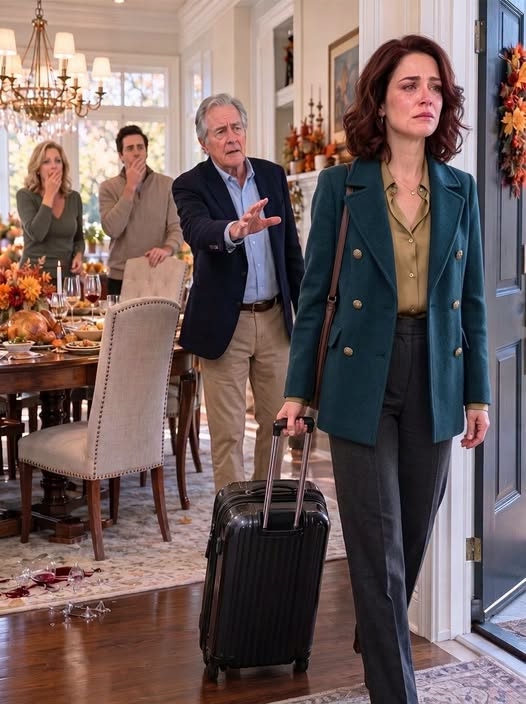
The light in the dining room fell in fractured amber diamonds across the mahogany table, thrown by the lead-crystal chandelier Emily had spent three weekends rewiring by hand. It was the kind of fixture meant for grand occasions, for homes rooted so deep in generational soil that nothing short of an earthquake could shake them. Twelve people sat beneath it, the room thick with the buttery smell of roasted heritage turkey, rosemary stuffing, and sweet roasted yams—all purchased via an automated grocery delivery linked directly to Emily’s primary checking account.
Arthur Vance sat at the head of the long table, his broad shoulders resting against the velvet upholstery of an antique captain’s chair. His linen napkin lay half-crumpled beside an imported pinot noir, and around his mouth lingered the faint, greasy sheen of gravy. He was sixty-two, his silver hair swept back with aristocratic vanity, though his skin carried the sallow puffiness of a man who had not earned a dollar of his own upkeep in over five years.
He picked up a silver dessert spoon and tapped the rim of his crystal goblet. The ping cut through the chatter of the cousins, silencing Jason’s boastful recount of his latest failed crypto arbitrage venture and Diane’s soft, manufactured laugh.
“Before we bring out the pies,” Arthur said, his voice carrying the deep, resonant cadence he had once used to persuade loan officers before the defaults began, “there is something that must be said. An honest reckoning for this house.”
Emily paused, her hand hovering over the bowl of cranberry compote she was passing toward her aunt Carol. The air tightened. Beside Arthur, Diane smoothed the sleeve of her cashmere cardigan—a birthday gift from Emily—and leaned forward, her thin lips curved into an expression of feline anticipation. Across the table, Jason slouched in his chair, twirling a salad fork between two knuckles, his heavy-lidded eyes fixed on Emily with a predatory gleam.
“We gather here every year,” Arthur continued, his gaze drifting over the guests before settling squarely on Emily, “talking about gratitude. About what keeps a bloodline whole. But there are fractures among us. Grudges. Quiet resentments that act like rot in the floorboards. Some people believe that because they hold the ledger, they own the soul of a family.”
A nervous cough rose from Uncle Robert at the far end of the table. Carol stared down at her lap, suddenly very interested in the pleating of her napkin.
“A true home cannot exist under surveillance,” Arthur said, his tone dropping an octave, slipping effortlessly into practiced sorrow. “It cannot thrive when every loaf of bread is tallied as a moral debt. It poisons the table. And so, Emily… after much thought, and with the full agreement of those who actually care about preserving our peace, I have decided what must happen. The best Thanksgiving gift you could give this family would be to disappear from it.”
The silence that followed did not fall like a feather; it dropped like a slab of cold river slate.
Emily did not blink. The silver bowl in her hands was heavy, cold along its base where the condensation had gathered. She lowered it slowly until it met the lace tablecloth with a muffled thud.
For five seconds, the room existed in suspended animation. Then Jason broke it. A harsh, barking chuckle rattled out of his throat, and he reached for his wineglass. “Christ, Dad. Straight to the jugular.”
“Don’t turn this into a spectacle, Emily,” Diane chimed in, her voice smooth as melted tallow. Her eyes, pale and sharp behind designer tortoiseshell frames, glittered with vindication. “You’ve never fit here. You know you haven’t. You come into this house with that spreadsheet face of yours, checking off what everyone owes you, making your father feel like a tenant in his own ancestral home. It’s unseemly. You’re always keeping score.”
“A few bills,” Jason muttered, leaning across the table, shaking his head. “She thinks paying a few bills makes her queen of the castle. She’s been lording that furnace replacement over us for two years. As if any decent daughter wouldn’t have stepped up.”
Emily looked at her brother. Jason was thirty-four, his linen shirt unbuttoned one loop too low, wearing a gold watch he had bought with money Arthur had borrowed from her two summers ago to cover an “emergency dental surgery” that never happened. She looked at Diane, whose boutique wellness studio had folded quietly after eighteen months, its remaining lease obligations secretly absorbed into Emily’s personal line of credit so Arthur wouldn’t have to face Diane’s hysterical tears.
Then, she looked at her father.
Five years ago, Arthur had sat on the floor of this very hallway, weeping into his hands while foreclosure notices fluttered around him like autumn leaves. They’re going to auction it on the courthouse steps, Em, he had sobbed, his breath sour with bourbon. Your mother’s roses. The fireplace where you opened your first Christmas presents. It will kill me. It will literally kill me.
She had spent three hundred and forty thousand dollars of her own liquidated portfolio to retire the first mortgage. She had paid off forty-six thousand dollars in delinquent municipal property taxes, sixty-eight hundred to the utility board to stop the water shutoff, and another twelve thousand to replace the cracked cast-iron boiler before the pipes burst that winter. The title deed currently sat in an iron safe at her attorney’s office in downtown Philadelphia, registered solely and exclusively to Emily Vance.
This will always be your home too, Arthur had whispered that night, kissing her forehead with trembling, reverent lips. You’re my savior, Emily. You’re the only one who truly honors your mother’s memory.
“Is that really what you want?” Emily asked. Her voice was remarkably steady. It possessed neither the tremble of an injured child nor the venom of an insulted martyr. It was flat, clinical, like water poured into an empty glass.
Popular Posts
→- 1
- 2
- 3
- 4




Recently Viewed
Stories you read recently will appear here.





