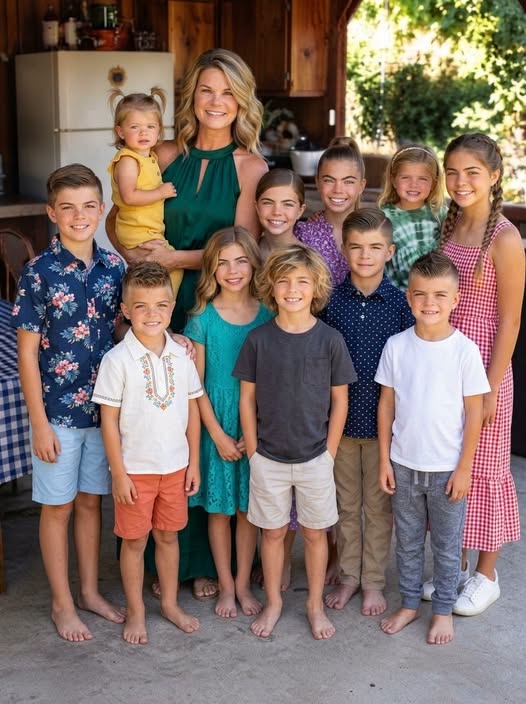
The salt-rimed windows of the Cape Fear freight office rattled under an unseasonable November gale, but inside the cedar-shingled house on Mulberry Street, the sound was muffled by three layers of laundry drying near the hearth and the uneven percussion of ten pairs of mismatched socks skimming across waxed pine.
Julian Vance stood by the icebox, his sleeve pinned with a safety pin where an eight-year-old’s enthusiastic tackle had separated seam from cuff. He was measuring whole milk into four separate blue enamel cups and six chipped ceramic mugs, humming a hymnal that had no business being sung with such secular cheer. His thumb, permanently calloused along the outer ridge from his years working the marine manifests down at the Wilmington docks, tapped a rhythm against the lip of the jug.
“Evelyn,” he called, not turning around, his ear attuned to the subtle difference between a four-year-old’s tumble and a six-year-old’s tactical drop from the banister. “The boy in the brown corduroys claims he cannot locate his second ear. He says Maya took it.”
From the center of the braided rug, Evelyn Mercer did not look up from the spelling primer she had propped against her knee. She reached out blindly with one arm, snagged the culprit—little Peter, whose brown trousers were indeed missing one brass knee-clasp—and hauled him into the crook of her elbow.
“Maya does not take ears on weekdays,” Evelyn said gravely, running a knuckle along the boy’s temple until he dissolved into high-pitched giggles. “The ear market is strictly Saturday morning between breakfast and the laundry line. Return to your spelling, Peter. If you spell wharf correctly, I’ll tell you why the pelicans sleep on the old pilings.”
From the kitchen threshold, Julian looked at her.
The look was not the casual appreciation of a suitor who had found a capable pair of hands to lighten his load. It was an expression so thick with bewildered reverence that it occasionally made Evelyn’s collarbones burn. He had lost his wife, Clara, to childbed fever forty-six hours after the twins had drawn their first breath into the damp coastal air; for three years, he had operated as an island battered by surf, his jaw locked in a permanent clench against the shame of being inadequate to the sheer mathematical scale of ten motherless children.
Then Evelyn had dropped her parasol on the gangplank of the river packet where he checked the manifests. He had retrieved it, his hand dark with grease from an iron winch, and instead of pulling back her lace, she had looked directly into the bloodshot, sleepless hollows of his gray eyes and asked if he had eaten since Tuesday.
That had been nineteen months ago.
“You’re squinting,” Julian murmured, carrying two cups toward her. He knelt on the floorboards, his long legs folding with the familiar creak of knees that had carried too many bags of seed across wet timber. He offered her a mug of chicory-heavy coffee. “Is the lamp chimney smoked again?”
“The wick is trimmed crooked,” she said, accepting the cup and letting her fingertips rest against his knuckles. “Marcus took the shears to cut fishing line.”
“I’ll speak to him.”
“Don’t. He used the line to fix the bottom drawer of the linen chest so the twins’ swaddling wouldn’t touch the floorboards. The boy is practical.”
Julian stared at the hand she had rested against his. His thumb moved slowly, tracing the silver band—a plain, unadorned hoop of hammered wire—that sat on the third finger of her left hand. It was an artisan’s ring, bought for seven dollars from an itinerant silversmith who traded behind the cotton exchange. In seven days, they were to stand before the circuit pastor at Saint Jude’s and turn that silver wire into gold.
“You’re certain?” he asked. The question had become a private liturgy between them, asked in the dead of evening when the house had finally settled into its rare, shallow sleep.
“I am certain of the kitchen floor,” she answered as she always did, smiling into his eyes. “I am certain that Peter eats dirt if he isn’t watched, and I am certain that the tide turns twice a day. What else is there to doubt?”
Julian did not answer with his customary jest. His gaze dropped to the floor, where the knot in the southern pine had curled like a blinded eye. His throat moved in a dry, swallow-swallow motion that drew her attention to the hard line of his jaw.
“Julian?”
“The wind is coming out of the north,” he said, rising so quickly the chicory sloshed over the rim of his cup. “The maritime registry says three barges came up from Charleston last night without manifests. They’re tying up at the south slips instead of the state docks.”
“What does the south slip have to do with the mutton stew for Sunday?”
He paused by the hall mirror—an old silvered glass whose backing had begun to flake away in great black scabs. In the reflection, his face appeared fragmented, divided into three separate panes of bone and shadow. “Nothing,” he whispered. “Nothing for you to fret over, Evie. I have to go down to the harbor master’s office before the shift changes.”
“At eight in the evening?”
“The manifests,” he said. The word was stiff, foreign in his mouth. “The harbor master wants the coal weights reconciled.”
He walked to the pegs by the front door, pulled down his oiled canvas coat, and turned. For three heartbeats, he looked at her across the width of the parlor. The children were still shouting in the stairwell—Marcus was herding the younger ones toward the basin with threats of cold river water, and Maya was singing a nursery rhyme to drown him out. The noise was an ocean, familiar and vast.
Julian stepped back across the rug. He did not mind the spills or the open primers. He caught her face in both of his palms—hands that smelled of bayberry soap, cold river iron, and the sharp, vinegar tang of salt spray—and kissed her on the mouth with a desperate, crushing finality that bruised her lower lip against her teeth.
Popular Posts
→- 1
- 2
- 3
- 4




Recently Viewed
Stories you read recently will appear here.