They Mocked the Old Man Until the Detective Called Him Chief
The call came while I was in the garage trying to coax one more season out of my battered pickup.
Rain tapped the metal door in a steady rhythm, and the air smelled like motor oil, wet concrete, and the coffee I had forgotten on the workbench.
When I saw Emily’s name, I wiped my hand on an old shop towel and answered with the easy voice I always used for her.
She did not answer easily.
“Dad, please come get me—he hit me again.”
The word again landed harder than everything that followed.
Before I could ask where Michael was, Emily screamed, something crashed, and the call ended.
For a second I stood perfectly still, listening to the refrigerator hum through the wall and the rain spit against the driveway.
Then I called her back.
No answer.
I called again and got voicemail.
By the third attempt, I had already grabbed my coat, my keys, and the emergency kit I kept behind the pickup seat.
I did not drive like a man in a movie.
I stopped at every red light because panic does not give anyone permission to create a second victim, but I took every turn with both hands locked around the wheel and my jaw clenched hard enough to ache.
The drive usually took thirty-five minutes.
I made it in twenty.
During those miles, every conversation from the past year rearranged itself in my memory.
Emily had started wearing long sleeves in warm weather.
She had canceled Sunday lunch three weeks in a row.
Michael had begun answering questions I asked her, and his mother, Jessica, had developed a habit of smiling whenever she called Emily “emotional.”
I had noticed all of it.
I had also respected my daughter when she said her marriage was difficult but manageable.
That is the line parents of grown children walk until the day the line disappears beneath their feet.
Michael’s driveway was empty except for Jessica’s SUV.
The front door stood half open, and the television was playing to an empty room.
I crossed the porch and heard the scrape of a shoe on hardwood.
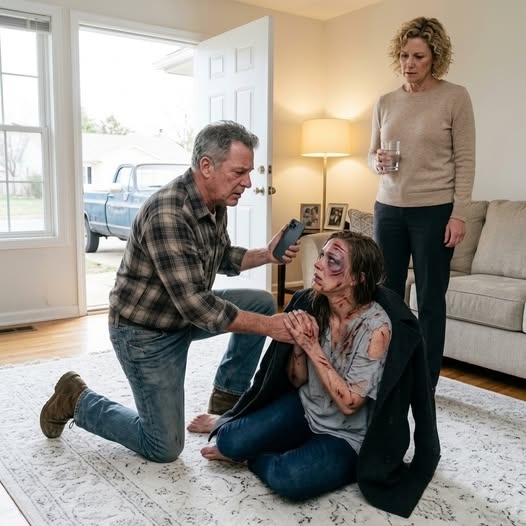
Then I saw Emily on the white Persian rug.
She was curled near the sofa with one cheek swollen, one sleeve torn at the seam, and damp hair stuck to the side of her face.
Her phone lay several feet away.
Jessica stood beside her with a glass of water in one hand and a look of mild annoyance on her face, as if Emily had spilled something expensive.
“There you are,” Jessica said. “She got hysterical again.”
I took off my coat and dropped to one knee.
Emily flinched when the fabric touched her shoulder, then caught my wrist with both hands.
“Dad, don’t let him come back in here.”
I asked where Michael was.
Jessica said he had gone for a drive to cool down.
She said Emily had tripped over the side table.
She said the blouse tore when Jessica tried to help her stand.
She said the swelling on Emily’s cheek must have happened when she struck the floor.
Each explanation arrived before I asked for it.
Power often sounds most confident right before it realizes someone is keeping a record.
I covered Emily from her shoulders to her knees and checked that she could breathe and answer simple questions.
She said her ribs hurt.
She said she felt dizzy.
She said Michael had taken her car keys earlier that evening and told her she was not leaving until she apologized to Jessica.
I wanted to find him.
For one ugly heartbeat, I pictured my fist going through the wall, then pictured Michael standing where the wall stood.
I let the thought pass.
Rage can make a man feel powerful while quietly stealing the one thing the person he loves needs from him most: judgment.
I took out my phone.
From the doorway, I photographed the whole room.
Then I photographed Emily’s phone where it had landed, the torn shoulder seam, the overturned side table, the red numbers on the digital clock, and the distance between each object.
I did not move anything.
I did not touch the phone.
Jessica’s voice sharpened.
“What are you doing?”
“Remembering accurately.”
She gave a short laugh and said a few pictures did not turn a family argument into a crime scene.
I ignored the phrase family argument.
At 8:06 p.m., according to my call log, I dialed emergency services and gave the address, Emily’s condition, Michael’s full name, and the direction Jessica said he had driven.
I asked for medical help and officers.
I identified myself only as the reporting party and the victim’s father.
Jessica heard that and relaxed.
She looked at my wet work boots, my old flannel shirt, and the battered pickup visible through the open door.
Whatever threat she had imagined when Emily called me, I did not look like it.
The first patrol officer arrived with two paramedics.
A second officer followed and asked everyone to stay in place while they separated statements.
One paramedic knelt beside Emily and began asking about pain, breathing, and dizziness.
Jessica answered for her twice.
The paramedic finally looked up and said, “I need her answers, not yours.”
That was the first moment Jessica’s confidence shifted.
The younger officer asked me to wait in the dining room.
I did.
He recorded my name, the time of the call, the route I had driven, what I saw from the doorway, and everything I had touched.
I showed him my call log and the photographs.
Then I handed over my phone so he could write down the exact image times without forwarding or altering the files.
“You know the drill,” he said before catching himself.
“I know enough to stay out of your way.”
Jessica heard us.
“You act like you know how this works,” she said.
I kept my eyes on the officer.
A few minutes later, headlights washed across the front window.
Popular Posts
→- 1
- 2
- 3
- 4




Recently Viewed
Stories you read recently will appear here.





