When I saw Olivia walk through the heavy glass doors, my stomach dropped. She was linked to Robert’s arm, not like a cherished partner, but like a prisoner being escorted to the gallows. She wore a high-necked, long-sleeved beige dress that swallowed her slender figure, a stark and deliberate departure from the vibrant jewel tones she used to love. Her smile, when she saw me, was a tight, brittle, porcelain mask that threatened to crack if she moved her jaw too much.
“Mom,” she greeted me, her lips trembling almost imperceptibly as they brushed against my cheek. She smelled of an expensive, suffocatingly floral perfume, and underneath it, the old, stale scent of fear.
“Honey, are you alright?” I whispered, gripping her hand. Her fingers were ice cold, lifeless in my grasp.
“I’m fine, Mom. Just… tired,” she said, her eyes darting to her husband, a quick, nervous flicker.
Robert loomed behind her. He was a handsome man in that sterile, corporate way—impeccable suit, perfect teeth, and eyes that didn’t just look at you, but appraised you, calculated your worth, and found you wanting. He was a wildly successful engineer, the golden boy of the formidable Armstrong family.
“Narissa,” he said, his voice as smooth and cool as polished granite. “You’re looking well.” It wasn’t a compliment; it was an assessment.
We sat. Robert’s parents, Mr. Armstrong Sr. and his wife, Susan, joined us moments later. Mr. Armstrong was a man who took up too much space in the world, his voice a gravelly, self-important boom that demanded attention and obedience. Susan was his shadow, a woman who had spent fifty years meticulously making herself small enough to fit in his pocket, her gaze perpetually fixed on her lap.
The sommelier, a young man with a nervous tic in his eye, approached. Robert, without consulting the menu, ordered the Dover sole, a dish famously delicate and expensive. Olivia, staring at the menu as if it were a complex architectural blueprint she couldn’t decipher, whispered, “I think… I’ll have the Pinot Noir, please.”
The air left the table.
Robert didn’t shout. He didn’t have to. His power lay in his chilling restraint. He slowly, deliberately, turned his head toward her, a predator locking onto a sudden, foolish movement. “Red wine?” he asked, his voice deceptively soft, a silken threat. “Olivia, you know perfectly well that I ordered the fish. Red wine does not pair with sole. Are you trying to embarrass me?”
“I… I’m sorry, honey,” Olivia stammered, shrinking back into her chair, her shoulders hunching. “I didn’t think.”
“No,” he said, turning back to the sommelier with a dismissive wave. “You never do. Bring her a glass of the Sancerre.”
The waiter froze, caught in the crossfire. I intervened, my own voice trembling with a mixture of anger and conditioned deference. “It doesn’t matter, Robert. Let her drink what she likes.”
Mr. Armstrong let out a dry, barking laugh that made heads turn at a nearby table. “Leave it, Narissa. The boy is right. He’s teaching her. Women today don’t even know how to order a drink properly. In my day, a wife waited to see what her husband chose, and she chose accordingly. It’s called respect.”
Olivia, desperate to dissipate the tension, reached for the bread basket. Her hand was shaking so violently that the basket rattled against the table. As she stretched her arm across the white linen, the long, modest sleeve of her beige dress rode up. Just an inch. Not even. But it was enough.
There, on the tender, pale skin of her inner wrist, were the marks. Three distinct, yellowing ovals, perfectly spaced. Fingerprints. The ghost of a grip that had been too hard, for too long.
My heart hammered a frantic, terrified rhythm against my ribs. Olivia.
She saw me looking. She saw the horror dawn on my face. She yanked the sleeve down with a convulsive jerk, her eyes wide with a desperate, panicked plea that screamed across the table: Don’t. Please, Mom. Don’t say anything. Don’t make it worse.
And like a coward, like a good, peace-keeping woman, I stayed quiet.
The dinner continued, a grotesque charade of civility. But then, the dessert arrived. The waiter, a different one this time, placed a slice of pecan pie in front of Olivia instead of the cheesecake she had quietly requested.
“Excuse me,” Robert snapped his fingers, a sound as sharp and ugly as a whip crack. “Is this how you run this establishment? Incompetence seems to be the theme of the evening.”
“Honey, it’s fine,” Olivia whispered, her eyes darting around, her face flushed with humiliation. “Please. I’ll eat the pecan pie. I like pecan pie.”
“It’s not about the pie, Olivia!” Robert’s voice rose, cutting through the ambient, civilized chatter of the restaurant. “It’s about standards. It’s about expecting and receiving what you ask for. Are you always going to be such a conformist? So weak? So willing to accept less than you deserve?”
The irony was so thick, so suffocating, I felt like I was choking on it.
“Robert, please. You’re embarrassing me.”
And then, it happened. The mask of the charming, successful husband didn’t just slip; it was violently torn away.
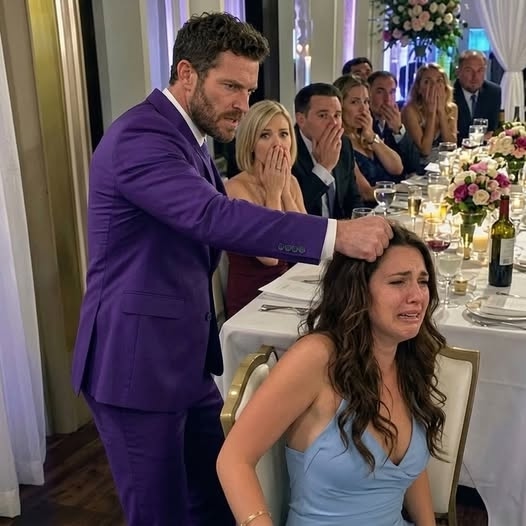
In a motion so swift and brutal it seemed rehearsed, a movement born of long practice, Robert reached out, grabbed a thick handful of my daughter’s dark, silky hair, and yanked her head back, exposing the long, graceful line of her throat.
The entire restaurant went silent. The music, a soft classical piece, seemed to stop. Olivia didn’t scream. She just let out a small, broken sob, her eyes squeezed shut as hot tears of shame and pain tracked through her perfect makeup.
In that horrifying, ringing silence, a new sound erupted.
Clap. Clap. Clap.
Popular Posts
→- 1
- 2
- 3
- 4




Recently Viewed
Stories you read recently will appear here.





