Part I — Disruption
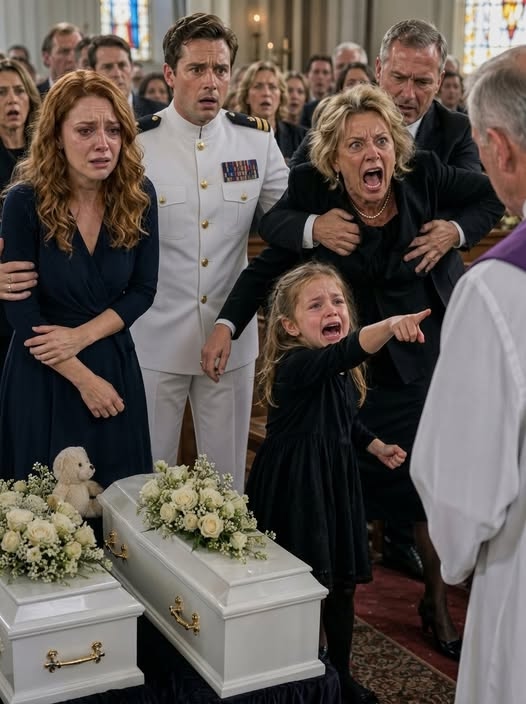
My mother-in-law slapped me beside my dead sons and whispered that I would join them if I spoke again.
For a second, I heard nothing.
Not the pastor praying at the front of the church. Not the soft crying behind me. Not the rain ticking against the stained-glass windows. Not even Trevor, my husband, shouting my name.
There was only the dull ringing inside my head where her hand had landed.
Then I looked down.
My cheek burned. My forehead was pressed against the polished edge of Noah’s coffin, and beneath the smell of lilies and candle wax I could still smell the cedar.
My son’s coffin.
My son.
Noah and Caleb had been four months old.
They had died in their sleep three nights earlier.
Two cribs. Two blankets. Two bodies that had gone still sometime before dawn.
And now my mother-in-law, Margaret Hale, was standing over me with one hand tangled in my hair.
“Shut up,” she whispered again.
Her fingers tightened.
“Or you’ll end up in there.”
I stared at her.
She stared back.
There was no grief in her face.
That was what frightened me most.
Margaret had cried loudly at the hospital. She had sobbed into Trevor’s shoulder and told every nurse within earshot that she could not imagine surviving the loss.
At the funeral, however, she had been different.
Controlled.
Watchful.
Almost irritated.
When she leaned close to me, her perfume smelled exactly as it had the night she came to our house after the boys died.
Lavender.
Something sharp beneath it.
I swallowed.
“Let go of me.”
She smiled without warmth.
“You’re still making this about yourself.”
A chair scraped behind us.
Trevor came toward us.
For one hopeful second, I thought he would pull his mother away.
Instead, he grabbed my arm.
“Enough, Rachel.”
I stared at him.
His face was red.
“She just hit me.”
“I saw what you did.”
“What I did?”
“You screamed at her.”
“She told me God took our babies because of me.”
His jaw tightened.
“Mom is grieving.”
I laughed once.
It was a terrible sound.
“So am I.”
Trevor looked toward the coffins.
His eyes were swollen. He hadn’t slept properly since the boys died. His shirt collar was crooked, and there was a faint coffee stain near his cuff.
He looked like my husband.
The man who had held my hand through labor.
The man who had painted the nursery walls pale blue because I couldn’t decide between blue and gray.
The man who had stayed awake for three nights after the twins were born because he was terrified they would stop breathing.
The man who had kissed my forehead yesterday and whispered, We’ll get through this.
But at that moment, he stood between me and his mother.
And he said, “You need to leave.”
My mouth went dry.
“What?”
“Go home.”
“This is my sons’ funeral.”
“I know.”
“Then why are you asking me to leave?”
“Because you’re making a scene.”
Margaret adjusted her coat.
She didn’t look at me.
She looked at Trevor.
And in that tiny movement, I saw something I had never noticed before.
Approval.
Like a teacher watching a student finally give the answer she wanted.
I pulled my arm from Trevor’s hand.
“You want me to leave my children’s funeral because your mother insulted me?”
“That’s not what I said.”
“It is exactly what you said.”
Rachel.
My name came from the front of the church.
A small voice.
I turned.
Emma stood beside the first row.
My four-year-old daughter was wearing the yellow dress I had bought her because she had refused every black one in the closet.
Her little hands were folded in front of her.
Her face was pale.
She was looking at the pastor.
Not at me.
Not at Trevor.
Not at Margaret.
At Pastor Daniel.
“Emma?” he said gently.
She took one step forward.
Then another.
“Pastor?”
“Yes, sweetheart?”
Her lower lip trembled.
“Do I have to tell everyone what Grandma put in the babies’ bottles?”
The church went silent.
Not quiet.
Silent.
The kind of silence in which you can hear someone breathing three rows away.
Margaret’s face changed.
It happened so quickly that if I had blinked, I might have missed it.
Her mouth opened.
Her eyes widened.
And the color drained from her face.
Trevor turned toward her.
“Mom?”
Emma looked at me.
Her eyes filled with tears.
I couldn’t move.
“What did you say, honey?”
She rubbed her sleeve across her nose.
“Grandma put something in the babies’ bottles.”
Margaret stepped forward.
“That’s a lie.”
Pastor Daniel raised one hand.
“Margaret.”
“She’s four years old.”
“She is.”
“She doesn’t understand what she’s saying.”
Emma’s voice became louder.
“I do understand.”
Margaret froze.
Emma looked toward the coffins.
“She did it at her house.”
My stomach dropped.
“Emma,” I whispered.
“I saw her that night.”
Trevor moved closer to our daughter.
“What night?”
“The night the babies went to sleep.”
His face went white.
Margaret shook her head.
“No.”
Emma continued.
“Grandma was talking on the phone.”
“Emma, honey, come here,” Trevor said.
But she didn’t move.
“She said she would fix everything.”
Margaret’s voice cracked.
“Stop.”
Emma flinched.
Pastor Daniel stepped between them.
“Margaret, please.”
Emma pointed at her grandmother.
“She said the children would be better off in heaven.”
A murmur moved through the church.
Trevor stared at his mother.
“What did she say?”
Margaret shook her head.
“Nothing. She said nothing.”
Emma wiped her cheeks.
“She mixed the powder.”
“What powder?” Trevor asked.
“In special bottles.”
My knees weakened.
I gripped the edge of the coffin.
Emma looked directly at me.
“Just like Mom’s.”
I stopped breathing.
Trevor looked at me.
“What does that mean?”
“I don’t know.”
I did.
Or rather, I suddenly remembered something I had spent weeks refusing to think about.
The bottles.
The special bottles.
The ones I had started using when the boys were six weeks old because they had struggled with feeding.
Popular Posts
→- 1
- 2
- 3
- 4




Recently Viewed
Stories you read recently will appear here.





