Act I: The Fracture
The smell of ozone, scorched rubber, and hospital disinfectant clung to Lucía’s skin like an indelible stain.
Every shallow breath felt like a shard of broken glass scraping against the inside of her chest wall. Her fourth and fifth ribs on the right side were cracked, and her left wrist was encased in rigid, chalk-white plaster that throbbed to the relentless tempo of her racing pulse. Above her head, fluorescent lighting hummed a sterile, indifferent drone. Outside the narrow window of Room 214 at the Hospital General del Sur in Puebla, late-October rain lashed against the panes in violent, diagonal sheets.
Barely three hours had passed since the paramedics had cut her out of the crumpled wreckage of her silver compact car on the Periférico Ecológico. She remembered the blinding halo of high beams cutting through the downpour, the sickening slide of bald tires on slick asphalt, the deafening crush of metal against the rear bumper of an SUV, and the sudden, suffocating explosion of the steering-wheel airbag.
Yet the pain from the impact was nothing compared to the violent tremor that seized her when the door to Room 214 was kicked open.
Esteban didn’t enter as a relieved spouse. He crossed the threshold like an auditor confronting a defaulting debtor.
His charcoal overcoat was damp at the shoulders, his thinning dark hair plastered to his forehead with cold sweat. His jaw was locked so tight the cords in his neck stood out like taut wire. He didn’t look at her splinted arm, nor at the oxygen cannula resting against her upper lip, nor at the purple contusion flowering across her cheekbone. His bloodshot eyes zeroed directly in on the monitors, the intravenous bag dangling overhead, and the paper chart hanging from the footboard.
“Get up right now,” he said. His voice was pitched low, vibrating with a venomous urgency that made the hair on the back of Lucía’s neck stand up.
“Esteban…” Lucía managed, her throat parched, every syllable catching against her bruised diaphragm. “Please… the doctors said I have a severe concussion… they haven’t finished—”
“I am not going to pay for another night of your drama!”
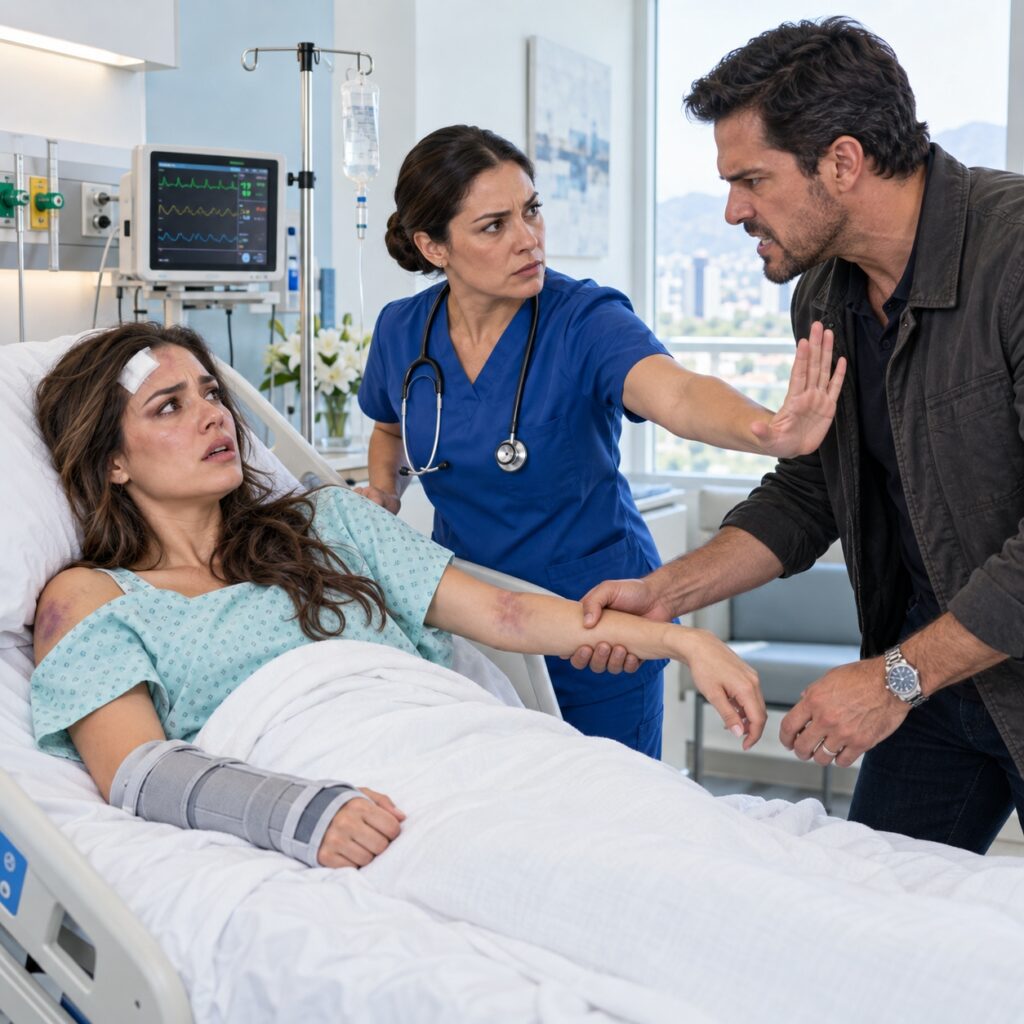
With a swift, aggressive motion, he reached out, seized the thin hospital sheet, and ripped it down to the foot of the bed. Before Lucía could pull away, his fingers clamped around her uninjured right forearm—right over the dark, tender hematoma left by the IV needle.
Lucía cried out, an involuntary, ragged sound that echoed down the quiet hallway.
“Get your shoes,” Esteban hissed, leaning down until his sour breath washed over her face. “You’re walking out of here on your own two feet. Do you have any idea what an overnight stay costs in a private trauma ward? Do you think money grows on the walls of that house?”
He hauled upward, attempting to force her torso upright. The torque wrenched her broken wrist against the metal guardrail, sending a white-hot flash of agony shooting up her spine. Black spots swarmed her vision.
“Let go of the patient.”
The command was calm, sharp, and delivered with the clinical authority of a scalpel.
Nurse Ximena walked into the room without hesitation, stepping directly between Esteban and the edge of the bed. She placed a firm, gloved hand over Esteban’s wrist, applying precise pressure to the tendon until his fingers uncoiled from Lucía’s bruised flesh.
Ximena was a woman in her late thirties, with keen, steady obsidian eyes, dark hair secured in an immaculate bun, and the unyielding posture of someone who had spent fifteen years running municipal trauma wards. She didn’t flinch as Esteban straightened to his full height.
“Back away from the bed, sir,” Ximena instructed, checking the pulse oximeter that had begun beeping erratically.
“She’s my wife,” Esteban snarled, smoothing his coat with jerky, erratic movements. “This is a private family matter. I decide when and how we go home. She had a minor fender-bender because she wasn’t paying attention, and you people are inflating the bill with useless nonsense.”
Ximena didn’t look at him; she adjusted the IV flow rate and rested two fingers gently against Lucía’s clammy forehead. “The patient suffered two fractured ribs, an unstable radial fracture, a grade-two concussion, and dangerously depressed vital signs. She is not cleared to sit up, let alone walk out into a rainstorm.”
“The accident wasn’t that serious,” Esteban shot back, raising his voice so loudly that an orderly in the corridor glanced in through the observation window. “She always exaggerates! She gets a scratch and acts like she’s on her deathbed! She’s been pulling this pathetic hypochondriac act for months just to shirk her responsibilities at home!”
Ximena turned her head slowly, looking past Esteban’s twitching mouth, and met Lucía’s eyes.
“Señora Lucía,” the nurse asked, her tone deliberately slow and level. “Do you want to leave this hospital tonight?”
“No,” Lucía whispered. The word came from the bottom of her bruised lungs—a small, terrified seed of resistance. “No, I don’t.”
Esteban’s jaw ground audibly. The air between them grew suffocating.
For eight years, every breath Lucía took in their house in San Pedro Cholula had been measured against an invisible ledger. Esteban had questioned the receipt for every carton of milk, the cost of winter gas, the small change she gave to the grocery baggers, and every fifty-peso copay at the community clinic. When she bought new shoes for work, he accused her of sabotaging their household savings; when she suggested taking a weekend trip to Veracruz, he went silent for three days, leaving utility bills open on the dining table as a silent reprimand. He had systematically severed her connections with her friends, telling her they were materialistic parasites, and had poisoned her relationship with her older sister, Marcela, insisting that Marcela’s calls were merely disguised attempts to meddle in their marital finances.
Popular Posts
→- 1
- 2
- 3
- 4




Recently Viewed
Stories you read recently will appear here.





