The grandfather clock in the foyer struck five with heavy, mournful chimes that shuddered through the floorboards. In the cavernous dining room of the Oleso estate, the afternoon light was dying, bleeding out into bruised purples and grays across the high arched windows.
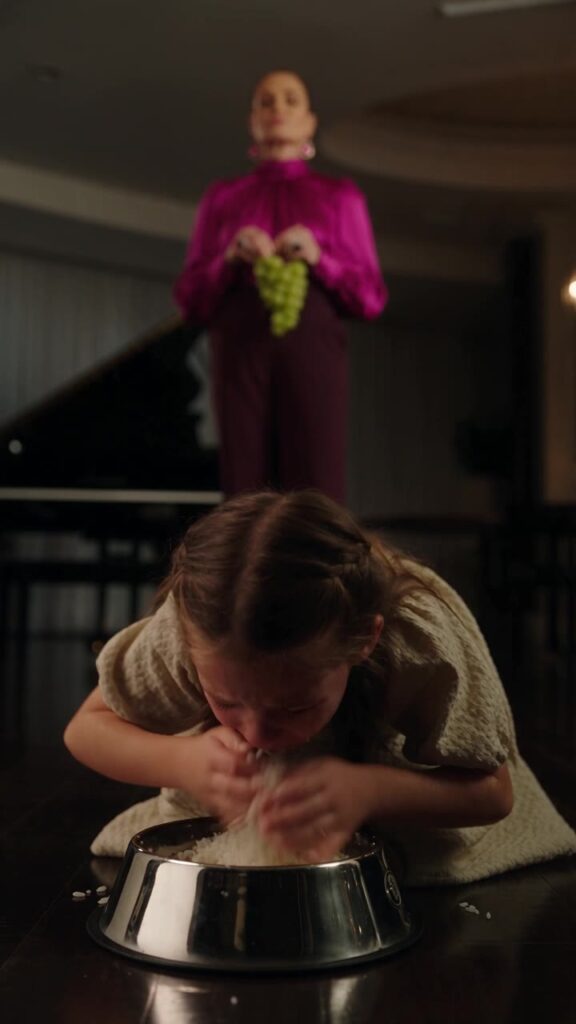
Amara knelt on the cold parquet floor, her bare knees bruised from the hard timber. In front of her sat a dull stainless-steel bowl, its bottom scratched from years of holding kibble for a retriever that had died two winters ago. Now, it held a fistful of yesterday’s jasmine rice—refrigerated, dry, and congealed into chalky white clumps.
“Don’t just stare at it, Amara. Waste is an ugly habit,” Celeste murmured from her place at the head of the long mahogany table.
Celeste did not look down. She sat with an immaculate posture honed by years of private academies and high-society galas, clad in an emerald silk blouse that caught the pale chandelier light. Her slender fingers delicately separated a plump green grape from its stem. She brought it to her painted lips, biting down with a faint, moist snap.
Amara swallowed hard, her mouth tasting like copper and dry dust. Her ribs pressed sharply against the worn cotton of her hand-me-down t-shirt. She had counted the hours since she last ate: twenty-nine. The previous morning, Celeste had poured her glass of milk down the sink because Amara had set it down too loudly on the breakfast counter, declaring that insolent girls did not deserve sustenance provided by a father they failed to respect.
“Please,” Amara whispered. Her throat felt scraped raw, her voice no louder than the scrape of fallen leaves outside. “Please, Mother Celeste… my stomach hurts. I can sit at the corner. Just a plate, please.”
Celeste paused, patting the corner of her lips with a linen napkin embroidered with the family crest—a crest she had married into barely fourteen months ago. Her dark eyes, ringed in charcoal liner, slid down toward the child on the floor. There was no hot fury in them; there was only the vacant, chilling curiosity of a boy observing an ant beneath a magnifying glass.
“A plate is for someone who behaves like a civilized human being,” Celeste said, her tone smooth, melodic, and entirely devoid of warmth. “You spilled the bath salts in my dressing room this morning. You wept when I told you to scrub the grout. You act like a stray animal, Amara. And stray animals eat where they belong. Right there. No one is starving you. The food is right in front of your face. Eat, or I will have Elena throw it in the compost, and you can wait until tomorrow night.”
Amara looked down at the bowl. A shudder ran from the base of her neck down her spine. The instinct to survive wrestled with the sickening humiliation burning in her chest. She had tried fighting before. When Celeste had first moved in after her mother’s death, Amara had screamed, had thrown tantrums, had run to her father. But Celeste was an architect of subtle cruelty; she knew how to leave marks that didn’t bruise the skin. She had isolated Amara, whispering to Richard that the girl was pathological, deeply traumatized, and prone to hysterical fabrications to drive a wedge between them. When Richard was away on business trips securing foreign contracts, the house became a fortress of quiet terror.
Tears spilled over Amara’s lower lashes, tracking hot paths down her dusty cheeks. Trembling, she leaned lower. She plunged her fingers into the cold, sticky clump of rice, scooped a portion, and lifted it to her mouth.
It was freezing. It smelled faintly of the metal bowl and stale refrigerator air. She chewed mechanically, her gag reflex kicking in as the dry grains caught in her throat. She choked back a sob, forcing herself to swallow. A stray grain adhered to her lower lip; another dropped onto the dark grain of the wood.
“Dreadful manners,” Celeste sighed, rising from the table. She smoothed her skirt, the heavy ruby drops at her earlobes swaying with the motion. “Finish every bite. If there is a single grain left when I return from my call, you will sleep in the mudroom tonight.”
Her stilettos clicked sharply across the floor, echoing like hammer strikes against marble as she disappeared down the long corridor toward the east-wing study.
From behind the service door connecting the dining hall to the butler’s pantry, Elena stood frozen. Her hand was clamped over her mouth so tightly her teeth bit into the flesh of her palm. Her heart was slamming against her ribcage like a trapped bird.
Elena had worked for the Oleso family for three years. She had known Amara’s biological mother, Clara, a gentle woman who smelled of lavender and played Chopin until the house felt golden. Elena had stayed through Clara’s illness, through the devastating funeral, and through the disorienting arrival of Celeste six months later.
Elena had witnessed the gradual erosion of the household’s soul. First, it was the dismissal of the old cook and the gardener. Then came the coldness toward Amara—the canceled piano lessons, the clothes bought two sizes too small, the subtle pinches when Richard’s back was turned, the endless chores piled onto an eight-year-old’s frail shoulders. Elena had wanted to speak, but she was a woman on a work visa with an ailing mother back in Manila. Celeste had reminded her of that fact on more than one occasion, smiling sweetly while noting how easy it was to report a domestic worker for theft and cancel a sponsorship.
Keep your head down, do your work, send money home, Elena had told herself every night in her small attic room.
But looking through the brass mesh of the swinging door, seeing Amara—Clara’s bright, sweet little girl—on her hands and knees, eating cold rice out of an animal’s bowl with tears dripping into the food, something inside Elena broke. The fear that had kept her tongue tied dissolved, replaced by a cold, white-hot clarity. Some lines, once crossed, forfeit all safety. To remain silent now would make her an accomplice to murder—if not of the child’s body, then of her spirit.
Popular Posts
→- 1
- 2
- 3
- 4




Recently Viewed
Stories you read recently will appear here.





