After Her Son Smirked and Told Her to Survive on Her Own, a Retired Nurse Walked Out of Christmas Dinner — What the Sealed Envelope and a Forgotten Clause Revealed Took Back a House and Every Dollar They Had Counted On
On Christmas Night, a Daughter-in-Law Screamed “Pay Rent or Get Out” at a Sixty-Eight-Year-Old Woman Still Holding Warm Pecan Pie — And When She Looked to Her Son, the Whole Table Waited for the Only Answer That Could Stop What Came Next
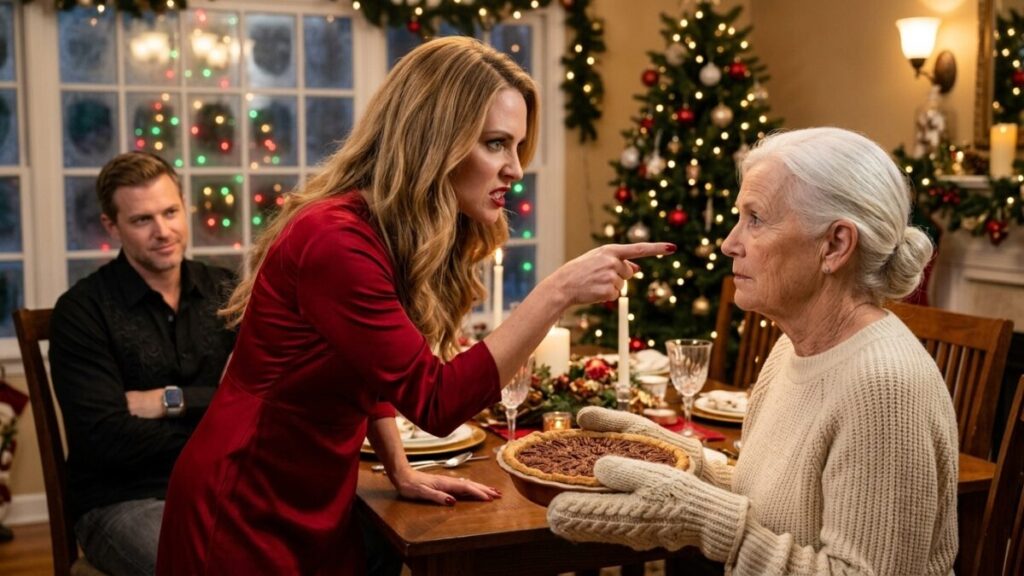
The pecan pie was still leaking heat through the oven mitts when Celeste stood from the Christmas table and shouted into Rhonda’s face, “Pay the rent or get out,” while red and green lights stuttered across the frost on the window and the turkey Rhonda had spent four hours preparing sat half-eaten on plates nobody had thanked her for — the kind of silence that makes a dining room feel colder than the winter pressed against the glass.
Celeste’s crimson nails — the ones Rhonda had paid for at the salon the week before — pointed like small weapons, and her perfume, another gift, filled the narrowing space as she announced that the arrangement was finished, that Rhonda, sixty-eight, was living rent-free in what used to be her own house, taking up space, using their utilities, eating their food — their food, the bird bought with a Social Security check, the stuffing from bread she had purchased, the vegetables she had peeled while her daughter-in-law sat in a salon chair.
“I contribute,” Rhonda said, and her voice came out smaller than the nurse who had worked thirty-five years wanted it to, listing groceries and cooking and cleaning until Celeste cut across her with three words that landed like stones: “That’s not rent.” This was their house now, Celeste said, because they paid the mortgage and the bills and needed a home office for Garrett’s expanding business, and then she named the figure without blinking — twelve hundred a month, decide by New Year’s — a sum that would leave two hundred from a fourteen-hundred-dollar check for medicine, insurance, gas, and everything else required to stay alive.
Rhonda turned to her son, sprawled in the reclaimed-oak chair his father, Philip, had built forty years ago in the garage, and Garrett met her eyes for one second before looking away to pick at a sleeve that held nothing, while two teenagers at the far end kept their thumbs moving and did not look up when their mother’s voice rose against their grandmother in the house Rhonda had signed over three years earlier on a promise of forever.
She looked at the boy she had rocked through thunderstorms, the teenager she had driven to baseball six days a week, the young man whose college she had funded with double hospital shifts, and she spoke his name as a question — “Garrett?” — and waited for the only person in that room who could still refuse this to open his mouth.
What he did with his face in the next breath — and the sentence he sent down that table like ice taking weight — is why people are still arguing about this Christmas dinner.
The Smile That Did Not Belong to a Son
His name left her mouth as a question, soft and broken, and for a moment the dining room held still around it — the half-eaten turkey cooling in its own fat, the pecan pie leaking heat through the mitts, the red and green lights stuttering on the frost. Garrett Winters looked up then, really looked, and he smiled. It was not the smile from thunderstorms or baseball parking lots or the afternoon he had watched her sign over the deed. This one belonged to a stranger who wanted the person across the table to feel the edge of the blade.
“Let’s see how you survive now, Mom,” he said, and the words traveled the length of the oak table like ice taking weight. “Welcome to the real world.”
Something in her chest gave way — not the grief that had already arrived when Philip died three years earlier, but a colder break, the sound of water choosing to become ice. She set the pecan pie on the table. Nobody reached for it. Celeste crossed her arms and waited for begging, for tears, for an apology about being a burden. The teenagers kept scrolling. Rhonda did not give any of them the satisfaction. She walked out of that dining room without another word, her shoes finding the floor she had mopped a thousand times, and she passed the living room where she had wrapped their Christmas gifts at midnight because wrapping paper cost money and she had wanted to save them some.
She went through the kitchen where she had stood four hours that morning. She walked to the converted garage they called a mother-in-law suite, which was a garage with a space heater and a bathroom so narrow she had to turn sideways to reach the toilet. It had no proper heating. It smelled like motor oil no matter how much she scrubbed. The cold clung to the blankets the way grease clung to the concrete.
What She Packed When Kindness Turned to Steel
Her hands shook as she pulled two suitcases from under the narrow bed, and the shaking was not fear. It felt like a power she had misplaced and suddenly recognized in her own palms. She packed her clothes first, each piece folded the way her mother had taught her sixty years earlier, as if neatness could keep a life from coming apart — sweaters Philip had bought for winter, the dress from his funeral, the practical cotton she had lived in since he got sick because pretty things stopped mattering when the person you dressed for was gone.
Popular Posts
→- 1
- 2
- 3
- 4




Recently Viewed
Stories you read recently will appear here.





