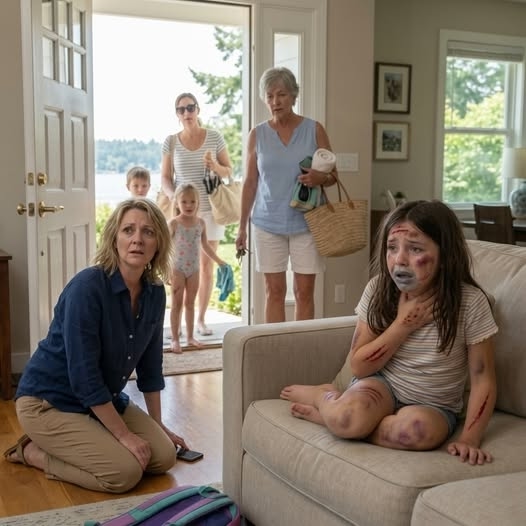
They Left My Daughter During Anaphylaxis—Then I Called Police
By the time I reached St. Agnes Children’s Hospital, my ten-year-old daughter had a clear oxygen mask pressed over her face and two IV lines taped across hands still small enough to disappear inside mine.
The emergency bay was bright, cold, and crowded with the controlled movement of people who knew exactly how close a child had come to dying.
A monitor chirped beside Lily’s bed while a nurse adjusted the tubing near her wrist and watched the numbers above her head.
I saw my daughter through the open doorway and moved toward her without thinking, but another nurse caught my arm before I crossed the threshold.
“Stay steady until she sees you,” she said quietly. “She needs to know you’re here.”
Every part of me wanted to run to Lily, pull the mask away, and hear her say she was all right, even though I knew removing that mask was the last thing anyone should do.
So I stayed upright.
I did not scream.
I did not collapse against the wall.
I stood in the hospital corridor and watched my daughter struggle to breathe because the people I trusted had decided her severe peanut allergy was probably just drama.
Three hours earlier, I had been presenting quarterly numbers in a downtown Seattle conference room.
A spreadsheet filled the wall-mounted screen behind me while department managers sat around a long table with paper coffee cups, notebooks, and the tired expressions of people already thinking about lunch.
My phone was on silent because the meeting had been scheduled for weeks, and I had promised my team I would give the presentation my full attention.
When the discussion finally paused, I glanced down expecting a calendar reminder or a routine message from Daniel.
Instead, I saw twelve missed calls from Lily’s school.
There was also a voicemail from the school nurse and one text from my sister-in-law, Claire.
Lily got into something with peanuts. We handled it. Don’t make a scene.
The words were so casual that my mind rejected them for half a second.
Lily did not simply get into peanuts.
Her allergy action plan used words like immediate, emergency, epinephrine, and 911.
Her EpiPen stayed in the front pocket of her backpack, and every adult who cared for her had been shown how to use it.
There was no version of a serious reaction that could be handled with a glass of water, a nap, or a promise to check on her later.
I stepped out of the conference room and called the school nurse.
She answered before the first ring had fully ended.
“Mrs. Carter, Lily left campus with your mother-in-law,” she said, and the fear in her voice was unmistakable. “She was wheezing. I told them to use the EpiPen and call 911. They said they had plans and would take care of it.”
My free hand flattened against the hallway wall.
“What do you mean, they had plans?”
“I don’t know,” she said. “I tried to stop them from leaving without calling an ambulance, but Lily’s grandmother said the family knew how to manage her allergy.”
I asked when they had left, whether Lily could still speak, and whether the nurse had personally seen the EpiPen.
She gave me every detail she could remember, including the fact that Lily had been frightened and had kept asking for me.
I called Patricia next.
My mother-in-law did not answer.
I called Daniel.
My husband did not answer either.
I called Claire three times before she finally picked up.
Behind her voice, I heard laughing children, splashing water, and someone calling for sunscreen.
“Where is Lily?” I asked.
Claire hesitated long enough for the sounds in the background to become painfully clear.
They were not in traffic.
They were not driving to an urgent care clinic.
They were already enjoying the day they had refused to cancel.
“Relax,” Claire said. “She’s with Mrs. DeLuca next door. We couldn’t cancel the lake club reservations. The other kids were so excited.”
For a moment, the office hallway seemed to shift beneath my shoes.
“You left my daughter with a neighbor during anaphylaxis?”
“She was breathing when we left.”
That sentence cut through my panic and left something colder behind.
Breathing was not the standard.
Alive was not the standard.
Safe was the standard, and they had walked away from her.
“Did anyone use her EpiPen?” I asked.
Claire sighed as though I were ruining a pleasant afternoon over a minor disagreement.
“Patricia didn’t think it was necessary, and Lily was making herself more upset.”
I ended the call before anger could steal time that Lily might not have.
Then I called 911 myself.
The dispatcher asked for Lily’s location, but I did not have Mrs. DeLuca’s full address.
I gave the dispatcher Patricia’s address, the neighbor’s last name, the school information, and everything I knew about Lily’s condition.
The dispatcher located the house, sent paramedics, and stayed on the line while I grabbed my bag and headed for the elevators.
I told a coworker that my daughter was having a medical emergency, but I barely heard the response.
By the time I reached the parking garage, the dispatcher was asking whether I was able to drive safely.
I said yes because there was no other answer I could tolerate.
Seattle traffic pressed around me as I drove toward the hospital with both hands locked around the steering wheel.
The dispatcher continued speaking in a calm voice, passing along updates whenever she received them.
Paramedics had reached the house.
Lily was conscious but in severe distress.
They had administered epinephrine.
They were transporting her.
Each update gave me one second of relief followed by another wave of fear.
I kept seeing Lily at breakfast that morning, pushing her cereal around the bowl while searching for a missing library book.
I remembered reminding her to check the EpiPen pocket in her backpack.
Popular Posts
→- 1
- 2
- 3
- 4




Recently Viewed
Stories you read recently will appear here.





