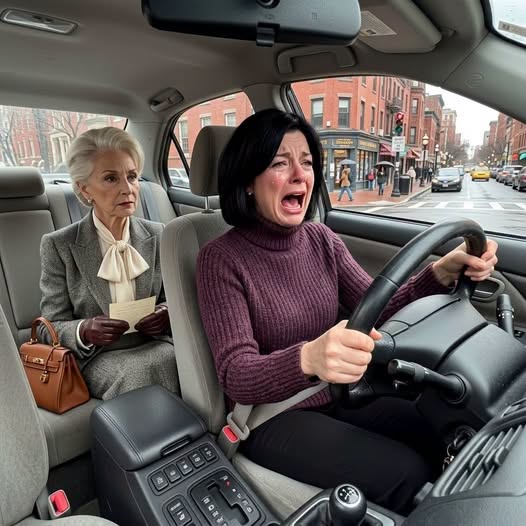
Part 1: The Woman in My Back Seat
The night my father-in-law destroyed my life, he spoke with the calm confidence of a man ordering dinner.
Judge Victor Halloway was not assigned to my divorce case, but everyone inside the courthouse knew him. Lawyers greeted him warmly. Clerks returned his calls. Judges treated him like an old friend.
By the time the hearing ended, I had lost nearly everything.
The $5.9 million house in Brookline was awarded to my husband, Grant. The dental clinic I had built from nothing was taken from me. My savings disappeared, my reputation was ruined, and three months later, my licence to practise dentistry was suspended.
Outside the courthouse, Grant adjusted his cufflinks and gave me a satisfied smile.
“You should have accepted the settlement.”
Victor leaned close enough for only me to hear.
“You will never work again, Madeline.”
At forty-six, I moved into a basement apartment in Somerville. It smelled of damp carpet and cleaning chemicals.
Both of my parents were dead. I had no family to rescue me and nowhere else to go.
To survive, I began driving for Uber.
Every day, I transported strangers through Boston while pretending I did not miss the weight of dental instruments in my hands.
Then, one rainy afternoon, I accepted a passenger travelling from Cambridge to Beacon Hill.
She was an elderly woman wearing an elegant camel-coloured coat. Her white hair was pinned neatly behind her head, and her eyes studied me through the rear-view mirror.
After several minutes, she spoke.
“You are Elaine Mercer’s daughter, aren’t you?”
My foot eased off the accelerator.
Elaine was my mother.
The woman introduced herself as Dr Vivian Ashcroft, founder of Ashcroft Meridian Biologics.
Then she told me something impossible.
My mother had not always been a school nurse.
She had been a brilliant chemist who helped create a major pharmaceutical company in the late 1970s. After discovering falsified research data, stolen patents and offshore financial schemes, she testified in a federal investigation.
When the case collapsed, she disappeared from the industry and raised me under a quieter identity.
But she had never surrendered her founder shares.
Instead, she placed them inside a private trust and named me as the only beneficiary.
Vivian leaned forward.
“After the company’s latest acquisition, your shares are worth approximately $312 million.”
My hands became cold against the steering wheel.
I turned off the engine because my leg had started trembling.
“My mother never told me any of this.”
“She was protecting you,” Vivian said. “And she was right to be careful.”
She explained that my name had appeared in a professional licensing complaint connected to a law firm associated with Victor Halloway.
Vivian knew immediately that someone had targeted me.
“He took everything from me,” I whispered.
“No,” she replied. “He took everything he could see.”
Within an hour, I was sitting in a private office with two attorneys, a trust officer and a security specialist.
On the table lay documents bearing my mother’s full signature.
The trust could not be activated until I was financially independent, legally competent and no longer under the coercive control of a spouse.
Losing everything had unknowingly satisfied those conditions.
But the lawyers warned me that Victor’s network was already searching for assets hidden under my name. If they discovered the trust, they might accuse me of concealing marital property.
I thought of Victor’s promise that I would never work again.
Then I signed the papers activating the trust.
Vivian watched me closely.
“Your mother once told me that if powerful men ever buried her daughter, I should give her a shovel.”
Part 2: The Architecture of My Destruction
Three days later, I stopped driving for Uber.
Not because I suddenly felt wealthy.
The number $312 million did not feel real. I was still a divorced woman wearing cheap shoes, waking every night with panic in my chest.
My attorneys instructed me to disappear from public view.
I moved into a secure apartment under a corporate lease. I avoided social media, ignored Grant’s messages and communicated only through counsel.
Then investigators began uncovering the truth.
A former federal prosecutor named Celeste Monroe placed the first report in front of me.
“Your divorce was not merely unfair,” she said. “It was engineered.”
There were emails between Grant’s attorney and an employee of the dental licensing board.
Payments had passed through consulting firms.
Victor had attended private dinners with men involved in the complaint against me.
Two former employees of my clinic admitted they had been paid to exaggerate problems with my patient records.
The accusation that destroyed my career involved supposedly improper sedation records for three elderly patients.
I always knew the claim was false.
But the original digital files had disappeared from the clinic server, and the backup submitted to the board had been altered.
Celeste’s team found another cloud archive that Grant’s people had missed.
It contained the original records.
They proved that I had followed every required procedure—and that someone had changed the files after the fact.
“Can I get my licence back?” I asked.
“Yes,” Celeste replied. “But the real question is how public you want this to become.”
I thought about hiding.
Then I remembered my mother hiding her brilliance for decades because powerful men had frightened her into silence.
“Public,” I said.
For six weeks, we built the case quietly.
Meanwhile, Grant sent mocking messages from blocked numbers.
He asked whether I was still driving strangers around.
He warned that his father would make sure the licensing board never reversed its decision.
I saved every message.
Our investigators discovered that Grant had emptied marital accounts before filing for divorce. His attorney had concealed financial disclosures. A valuation expert deliberately undervalued my clinic and later purchased its debt through a shell company.
They had planned to destroy my name, acquire my clinic cheaply and sell it later for a profit.
During one meeting, Vivian handed me a folder containing five letters written by my mother.
Popular Posts
→- 1
- 2
- 3
- 4




Recently Viewed
Stories you read recently will appear here.





