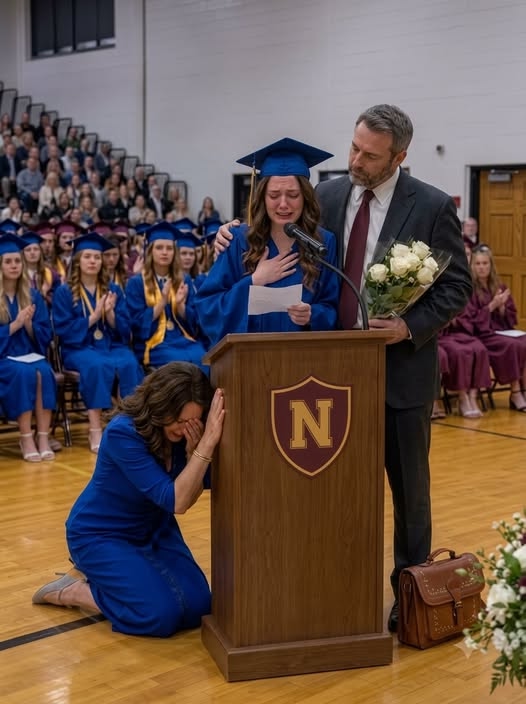
My daughter called me crying the morning of her graduation. Her mother had taken scissors to her cap and gown. All that remained was a pile of shredded fabric and a note that read: “You are not my daughter anymore. Failure.” She wanted to skip the ceremony completely, but I looked her straight in the eyes and said, “Get dressed. I already know what we’re going to do.” And when they announced her as valedictorian later that night, the entire auditorium rose to its feet. The color drained from her mother’s face the instant she realized why.
The call came on the morning my daughter was supposed to step into the brightest day of her young life, and for one horrible second, I thought someone had died.
I was standing in my downtown office, surrounded by blueprints, glass walls, and the quiet arrogance of a career I had spent thirty years building, when Lily’s name lit up my phone.
I smiled before answering, because it was graduation day, and I expected nerves, laughter, maybe some teenage panic about her hair or her tassel.
Instead, I heard my daughter sobbing so hard her breath broke into sharp, painful pieces.
“Dad,” Lily choked out, “she ruined everything.”
My hand tightened around the phone.
“Lily, slow down. Tell me what happened.”
There was a sound on the other end like fabric being dragged across a bed. Then my daughter’s voice came back smaller than I had ever heard it.
“Mom cut up my cap and gown. She cut it into pieces and left it on my bed.”
For a moment, the city beyond my office window disappeared. The award plaques on my wall, the Oakridge Civic Center plans spread across my desk, the polished walnut furniture — all of it became meaningless noise.
“She left a note,” Lily whispered. “It says I’m not her daughter anymore. It says I’m a failure.”
Something inside me went dangerously still.
I had known Meredith Sinclair for more than twenty years, and I had seen cruelty disguised as manners, control dressed up as concern, and emotional punishment delivered in a voice soft enough for dinner parties.
But this was different.
This was not a mother and daughter arguing.
Not a moment of anger that went too far.
This was a deliberate attempt to destroy a child’s confidence on the morning she was supposed to be honored.
“I can’t go,” Lily said, crying again. “I can’t walk across that stage with everyone staring at me. I just want to stay in my room and disappear.”
“No,” I said, already grabbing my keys from the desk. “You are not disappearing today.”
“Dad, I don’t even have anything to wear.”
“You listen to me very carefully,” I told her, keeping my voice calm because she needed strength, not rage. “Do not leave that house. Do not let anyone talk you out of anything. Get yourself ready, because I am coming to get you.”
“But what are we supposed to do?”
I looked down at the blueprints on my desk, at all those clean lines and load-bearing calculations that had taught me one simple truth.
When a structure is attacked, you protect the foundation first.
“We are going to make sure the whole town sees exactly who you are.”
The drive from my office to the Sinclair mansion took fifteen minutes, but every mile dragged twenty years of memories behind it.
I remembered meeting Meredith at a charity gala, her cream silk dress catching the light, her laughter sharp and beautiful, her eyes fixed on me like I was something rare.
Back then, I was not yet the architect people invited to private dinners and civic projects. I was only a hungry young man with dirt under his nails, student loans, and a stubborn belief that anything could be built if the foundation was strong enough.
Meredith told me she hated the fake perfection of her family’s world. She said she wanted something real, something honest, something untouched by the Sinclair obsession with money and appearance.
For a while, I believed her.
I believed it so deeply that I ignored the way she corrected my clothes before parties, rewrote my sentences in front of her friends, and smiled whenever her parents treated me like a fortunate outsider who had married above himself.
Then my firm became successful without the Sinclair name carrying it.
The moment I no longer needed her family’s doors to open for me, Meredith began treating my independence like betrayal.
Our marriage did not collapse all at once.
It cracked quietly, year after year, beneath her cold silences, her impossible standards, and her talent for making love feel like a privilege that could be taken away.
Lily had been trapped inside that house long after I left it. During our separation, Meredith turned our daughter into another battleground, another thing to claim, polish, control, and display.
The mansion rose at the end of a long stone driveway, all white columns and manicured hedges, beautiful in the same lifeless way Meredith admired everything.
Lily opened the front door before I knocked, and the sight of her nearly broke me.
She was seventeen, tall, bright-eyed, and usually stubborn enough to argue with thunder. But that morning, she stood in the foyer with swollen eyes, trembling hands, and the defeated posture of someone who had been told she was worthless by the one person who should have protected her.
“Show me,” I said softly.
She led me upstairs without a word.
Her bedroom still smelled of old books, rain-damp sneakers, and the lavender detergent Meredith insisted on buying in bulk because “proper homes should have a signature scent.”
The destruction lay across Lily’s bed like evidence from a crime scene.
Her navy graduation gown had been cut into thin strips, not ripped in a burst of anger, but sliced with patience, each ribbon of fabric arranged where Lily would be forced to see it.
The cap was bent in half.
Popular Posts
→- 1
- 2
- 3
- 4




Recently Viewed
Stories you read recently will appear here.





