My fiancé said, “Don’t call me your future husband.” I nodded. That night, I quietly removed my name from every guest list he’d made. Two days later, he walked into lunch and froze at what waited on his chair.
PART 1
“Did you break your leg, or did your hands stop working too? My mother hasn’t eaten all day, Madeline.”
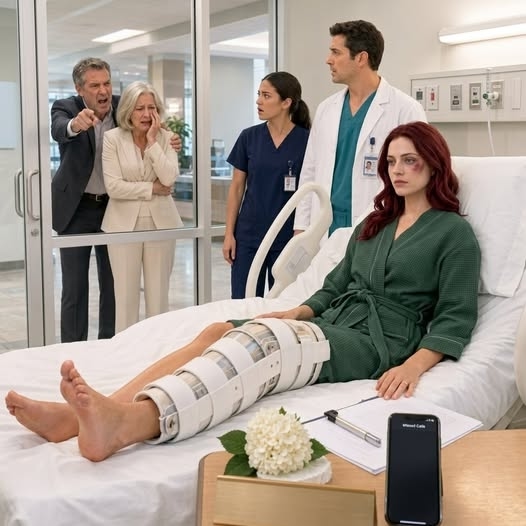
Julian Vance’s voice boomed emergency room cubicle as if the hospital were his personal living room and I were an employee who had clocked in late. My right leg was completely immobilized in a splint, a jagged laceration ran down my calf, and my dress was stained with dried crimson. I had been struck by a distracted driver right outside my artisanal bakery in downtown Chicago, just as I was stepping out to grab a crate of fresh strawberries for the day’s tarts.
The doctor paused mid-suture for a fraction of a second. The attending nurse turned to look at me, her eyes wide with shock. I deliberately left the phone on speaker because Julian had already called forty-seven times.
“I am at Northwestern Memorial Hospital,” I repeated, my throat completely parched. “My tibia is fractured.”
There was a brief, icy silence on the line. Then came his familiar, mocking chuckle.
“Always so dramatic. My mother needs her low-sodium lunch before two o’clock. Can’t you just call an Uber and get over here? I’m not asking you to run a marathon.”
I felt something shatter inside me, but it wasn’t my bone.
Throughout our three years of marriage, I had prepared meals for his mother, Eleanor, as if it were my natural-born duty. Fat-free breakfasts, bland broths, shredded chicken, sugar-free gelatin. Meanwhile, Julian constantly flaunted his prestigious title as Regional Director at Core Dynamics, a corporation he loudly claimed “couldn’t survive a single quarter without his brilliant leadership.”
“Your mother is no longer my responsibility,” I said, my voice dead calm.
“What did you just say?”
“And neither is this marriage.”
I hung up.
The nurse gently set my phone back down on the bedside table. She didn’t say a word, but her supportive gaze told me everything I had spent years trying to deny: this wasn’t marital fatigue. This was absolute emotional abuse disguised as family obligation.
Half an hour later, two police officers walked into the room.
“Madeline Brooks?” the lead officer asked.
I raised my hand slightly.
“Your husband filed an emergency domestic report, claiming you abandoned a dependent, elderly adult in medical distress.”
I let out a sharp, hollow laugh. “I was struck by a vehicle at exactly 12:18 p.m. My admission records, X-rays, and the official traffic accident report are right there on that clipboard. I didn’t abandon anyone. I am currently hospitalized.”
The older officer inspected my mangled leg, then glanced at my phone’s call history. “Forty-seven missed calls?”
“All from him, demanding I leave the hospital to cook his mother’s lunch.”
The doctor stepped in, adjusting his gloves. “The patient cannot walk, officer. If you need an official medical certificate for your precinct, I will sign it right now.”
I asked the officers to call Julian back using their official department line. He answered instantly, his tone dripping with irritation. “Who is this?”
“Chicago Police Department. Your wife is currently hospitalized following a severe traffic collision. Your domestic report does not align with the verified facts.”
May you like
Julian began to stammer frantically. “I… I didn’t realize it was actually that serious.”
“You didn’t know because you never bothered to ask,” I called out from the hospital bed.
Hearing my voice, his tone shifted instantly into a low, venomous hiss. “Madeline, are you seriously going to make me look like a monster over a missed lunch? If you want a divorce, fine. But the Gold Coast estate, the luxury SUV, and every single dollar in our accounts stay with me. You can walk out with your broken leg and the clothes on your back.”
I stared up at the sterile white ceiling tiles. “You’re entirely mistaken, Julian.”
“About what?” he sneered.
“I’m not walking out of your life empty-handed. I am withdrawing my capital.”
“What capital?” he mocked. “You own a tiny neighborhood kitchen.”
“The primary asset,” I whispered, “is myself.”
The moment the police officers left to file their reports, I requested certified copies of my medical charts, intake logs, and radiology scans. Then, I made four precise phone calls.
First call: To the bank. I ordered an immediate emergency freeze on our high-balance joint accounts due to unauthorized asset-depletion risks.
Second call: To my estate manager. I verified that the Gold Coast mansion was titled under a dual-signature clause, meaning it could never be sold or leveraged without my explicit authorization.
Third call: To Chloe, my fiercest friend. “Bring me a change of clothes, my encrypted laptop, and a charger. Then call Attorney Sophia Sterling.”
Fourth call: To Arthur Thorne, the global CEO of Core Dynamics.
“Ms. Brooks,” Arthur answered, his voice dropping into a tone of immediate, absolute respect.
“I need the complete internal file on Julian Vance, Central Regional Director. And Arthur? Schedule a surprise corporate audit for tomorrow morning. Make it look like a routine response to anonymous vendor complaints.”
Arthur paused for a single beat. “Understood. Are we finally revealing your position to the board?”
I looked down at the heavy fiberglass cast on my leg. “Not yet. I want to see exactly how comfortable he gets in the chair I bought for him.”
Because Julian didn’t know. None of his arrogant family members knew. Long before I ever met him, I had built the parent conglomerate that funded Core Dynamics, securing it safely inside a private legal trust called Aurora Capital. He genuinely believed I was just a stubborn local baker who smelled of vanilla and butter.
Fifteen minutes later, Julian and Eleanor stormed into the emergency room like a hurricane.
“Are you done with your little theatrical performance yet?” Julian barked, slamming the curtain aside.
Popular Posts
→- 1
- 2
- 3
- 4




Recently Viewed
Stories you read recently will appear here.





