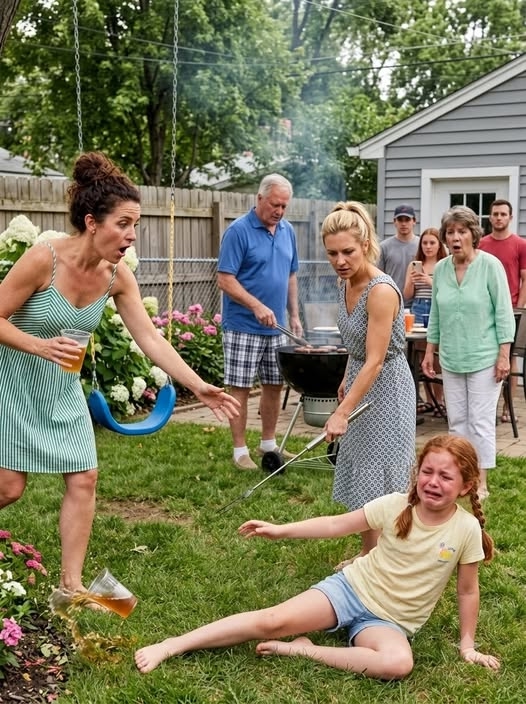
The sound my daughter made when her leg broke was quieter than the lie my family told about it.
At first, there was only the barbecue.
Smoke curled over my parents’ backyard in lazy gray ribbons. Hamburgers hissed on the grill. Cicadas screamed behind the chain-link fence, and somebody had turned an old country playlist loud enough that conversations had to compete with the music.
It was July.
Hot enough for the plastic patio chairs to sting bare legs.
Hot enough that nine-year-old Lily’s cheeks had turned pink beneath her freckles.
Hot enough that none of us understood, when the afternoon began, that before sunset my daughter would be inside an ambulance and my family would be deciding which version of the truth they planned to tell the police.
I was near my mother’s hydrangeas when I realized I hadn’t heard Lily for several minutes.
That was unusual.
Lily filled space naturally. She laughed loudly. Asked questions constantly. Sang fragments of songs with the wrong lyrics. Whenever children were together, you could usually locate my daughter without looking.
But the plastic swing beside the shed was moving by itself.
“Lily?”
No answer.
I glanced toward the aboveground pool.
Toward the grill.
Toward the patio, where my father, Robert, stood in a stained apron lecturing two neighbors about charcoal.
Then I saw her.
She was in the narrow strip of shade beside the wooden shed.
My younger sister Carla stood three feet away.
Carla wore a pale yellow summer dress, large sunglasses pushed onto her brown hair, and the irritated expression she had worn around me for most of our adult lives.
But it wasn’t her face that stopped me.
It was what she was holding.
A long steel roasting skewer.
One of the heavy ones my father kept near the fire pit.
“Lily?”
My daughter turned.
Carla’s arm moved.
There was a flash of steel.
Then Lily screamed.
I watched her collapse sideways onto the grass, hands flying toward her right leg.
The beer bottle slipped from my fingers.
It struck the flower-bed stones and shattered.
I ran.
“What the hell did you do?”
Carla didn’t kneel.
She didn’t drop the skewer.
She didn’t say it was an accident.
She looked down at Lily as if my daughter had spilled juice on an expensive rug.
“She was being disrespectful.”
I dropped beside Lily.
Her face had gone white.
“Mom.”
“I’m here.”
“It hurts.”
“I know, baby.”
She tried to straighten her leg.
The movement produced a strangled cry.
“Don’t move it.”
Her fingers wrapped around my wrist with astonishing strength.
Carla sighed behind me.
“You really need to teach her manners, Naomi.”
I looked up.
“What did you say?”
“She talked back.”
“She’s nine.”
“Nine is old enough to know better.”
“You hit her with a steel rod!”
“I barely touched her.”
“Barely—”
My voice broke.
Lily’s leg was already swelling.
My mother Diane hurried across the patio.
Her first words weren’t, What happened to Lily?
They weren’t, Should I call an ambulance?
She looked at me and said:
“Naomi, stop screaming.”
I stared at her.
“Carla hit Lily.”
My mother looked toward my sister.
“Carla, sweetheart?”
Carla crossed her arms, the skewer still dangling from one hand.
“She was being mouthy. I corrected her.”
My mother’s expression softened.
Toward Carla.
Not Lily.
That tiny movement—barely anything—was somehow more horrifying than the weapon.
“Mom,” I said slowly, “look at Lily’s leg.”
She glanced down.
“Children exaggerate pain.”
My father called from the grill.
“If she was misbehaving, somebody needed to discipline her.”
Lily heard him.
I felt her grip loosen.
Not because the pain had lessened.
Because something inside her had.
A nine-year-old girl had just discovered that the adults she called Grandma and Grandpa could look at her injured on the ground and decide their first responsibility was protecting the person who hurt her.
I pulled out my phone.
My mother saw the screen.
“What are you doing?”
“Calling 911.”
“For God’s sake.”
At 4:17 p.m., I told the dispatcher my daughter had been assaulted.
At 4:19, my father shouted that it had been an accident loudly enough for the dispatcher to hear him.
At 4:20, Carla finally dropped the skewer onto the grass.
At 4:22, I photographed it.
My mother’s face changed.
“Delete that.”
“No.”
“Naomi.”
“No.”
She stepped closer.
“You are turning a family disagreement into something ugly.”
I looked at Lily.
Tears ran silently into her hair.
“It’s already ugly.”
My mother lowered her voice.
“If you involve police against your own sister, don’t expect this family to forgive you.”
I remember looking at her then and feeling something very strange.
Relief.
Not because anything was okay.
Because for the first time in my life, I wasn’t confused.
I had spent thirty-six years wondering whether I was too sensitive.
Too dramatic.
Too difficult.
Whether Carla really had been favored or whether I simply remembered childhood unfairly.
Whether my mother’s cutting remarks were concern.
Whether my father’s silences were neutrality.
Whether keeping peace made me mature.
Watching my daughter lie broken on their lawn answered every question at once.
“No,” I said. “I don’t expect anything from you anymore.”
Sirens rose in the distance.
Carla’s expression finally changed.
She looked toward the gate.
“You’re seriously doing this?”
“I already did.”
My mother stepped so close that I smelled her rose perfume.
“If you file anything against us, you’ll regret it.”
“Against you?”
“Grandparents have rights too.”
She smiled.
A tiny, confident smile.
“We’ve been in Lily’s life since she was born. You can’t just erase us because you’re angry.”
My skin turned cold despite the heat.
“I’m not angry.”
“You certainly sound angry.”
“I’m protecting my child.”
My mother whispered:
“We’ll see what a judge thinks.”
The ambulance arrived at 4:31.
The paramedics opened the side gate.
My father moved directly in front of them.
“Hold on,” he said.
One paramedic, a broad-shouldered woman with dark hair, stopped.
“Sir, please move.”
“This is being blown out of proportion.”
Popular Posts
→- 1
- 2
- 3
- 4




Recently Viewed
Stories you read recently will appear here.





