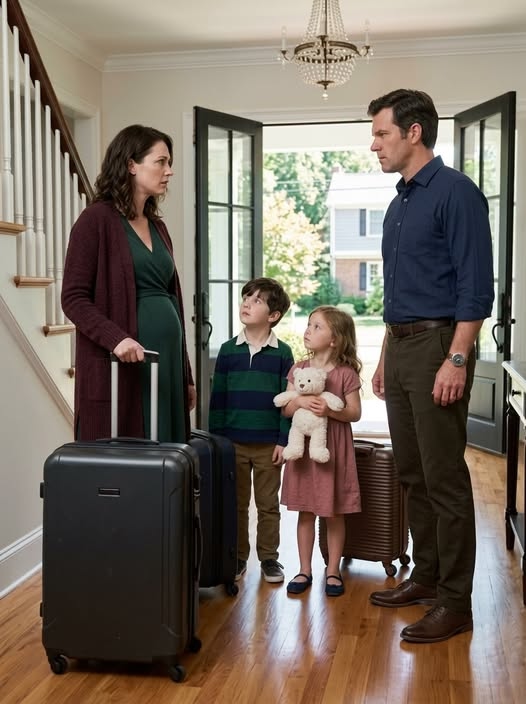
The water from the kitchen ceiling did not drip in a steady beat, but in irregular, heavy drops that hit the metal mixing bowl like small stones. I stood by the oak counter, adjusting the silver band of my wristwatch, while Ryan sorted through the mail.
He tossed a pile of colorful flyers and utility bills onto the granite island. The gold signet ring on his pinky finger clicked twice against the stone as he pushed a brown envelope aside.
“Five thousand dollars for a few square yards of asphalt shingles is absurd,” Ryan said. His voice had that flat, measured authority he used when addressing a room of subcontractors. “The roofing contractor is taking advantage of the neighborhood, Claire.”
“The dry rot is spreading to the rafters,” I said, pointing toward the hallway ceiling where the paint had begun to bubble. “If we do not fix it before the November rains, the plaster in the hallway will come down. We have the estimate from Miller Roofing, and they can start on Thursday.”
Ryan did not look up from a letter he was opening with his silver pocketknife. He sliced the paper with a clean, practiced motion.
“We simply do not have the liquid cash for the roof right now, Claire.”
The statement hung in the warm air of the kitchen, smelling faintly of the lemon detergent I had used to clean the tiles. It was a strange assertion for a man whose logistics company had just secured a three-year contract with the state. I watched him slide the pocketknife back into his trousers.
“Our joint savings index showed thirty-four thousand last Tuesday,” I said, keeping my voice as level as his. “The quarterly dividend from the commercial park was deposited on the first of the month.”
“That capital is earmarked for payroll taxes,” Ryan said, slide-stamping the utility bills into a neat stack. “I will not risk an IRS penalty to patch a roof we can cover with a blue tarp. We need to be smart about our liquid assets right now.”
“A blue tarp will lower the property value of every house on this bend,” I said. “And the homeowners association will fine us fifty dollars a day after the first week.”
“Let them fine us,” Ryan said. He looked at me with a calm, unblinking focus that usually silenced his project managers. “We will appeal it. The repairs can wait until spring.”
He took his brass ring of car keys from the ceramic bowl by the microwave and walked out to the garage, leaving the kitchen door swinging on its hinges.
The drip in the metal bowl sounded louder now that the house was quiet. I looked at the mail left on the counter, noticing a white envelope with no return address, postmarked from downtown Nashville.
I did not open it, but I tucked it under the wooden cutting board to examine later.
Outside, the afternoon sun had turned the maple leaves a dry, dusty gold. Ethan was sitting in the grass near the swing set, pushing a small blue plastic tractor through a hill of dirt he had cleared from the edge of my flowerbed.
He was six, but he moved with a quiet caution that belonged to a much older child, never raising his voice or making a mess he could not easily sweep away. He kept his stuffed rabbit, its ears greyed from years of holding, tucked securely under his left arm while he dug.
“Mom, can we go to the library tomorrow?” Ethan asked, not looking up from his dirt road. “The lady with the glasses said they have the new book about the triceratops.”
“We can go right after your speech therapy,” I said, sitting on the painted wooden bench near the back porch. “But you have to finish your green beans at dinner tonight.”
“I will,” he said, using his thumb to smooth out a tiny dirt ramp. “Is Daddy going to be home to watch me ride my bike?”
“He has a late meeting in town tonight, sweetheart,” I said, keeping my gaze fixed on the road beyond our picket fence.
A charcoal sedan, an ordinary model used by corporate fleets, was parked near the fire hydrant. The engine was idling, releasing a thin wisp of exhaust into the cool autumn air.
The driver side window was tinted dark, blocking any view of the person sitting behind the wheel. It had been parked there since three o’clock, sitting perfectly still.
“Look at this hill, Mom,” Ethan said, pointing his plastic tractor toward a mound of dry earth. “It is the biggest one in the yard.”
“It is very big, Ethan,” I said, my hand instinctively checking the watch on my wrist.
I stood up and walked slowly toward the side gate, my sneakers crunching on the dry leaves. The car did not move until I lifted the iron latch of the gate.
As the wood creaked open, the sedan shifted into gear and moved slowly down the street, turning the corner without using its indicator.
I memorized the partial plate, three letters and a single digit, before the vehicle vanished behind the neighborhood hedge.
I walked back to Ethan and smoothed his hair, wishing I could shake the cold feeling that someone was measuring the distance between our front door and the street.
Margaret arrived at seven, carrying a covered glass dish of squash casserole that was already lukewarm. She set her leather purse on the side table and immediately began adjusting the framed photographs on the mantelpiece, tilting the picture of Ethan’s third birthday a fraction of an inch to the left.
“You look drawn, Claire,” Margaret said, her southern accent clipping the ends of her words. “You must take care of yourself with another child on the way. You cannot carry the whole world.”
“I am fine, Margaret,” I said, sitting on the edge of the sofa. “The roof is leaking, which makes sleeping a bit difficult with the noise.”
Popular Posts
→- 1
- 2
- 3
- 4




Recently Viewed
Stories you read recently will appear here.





