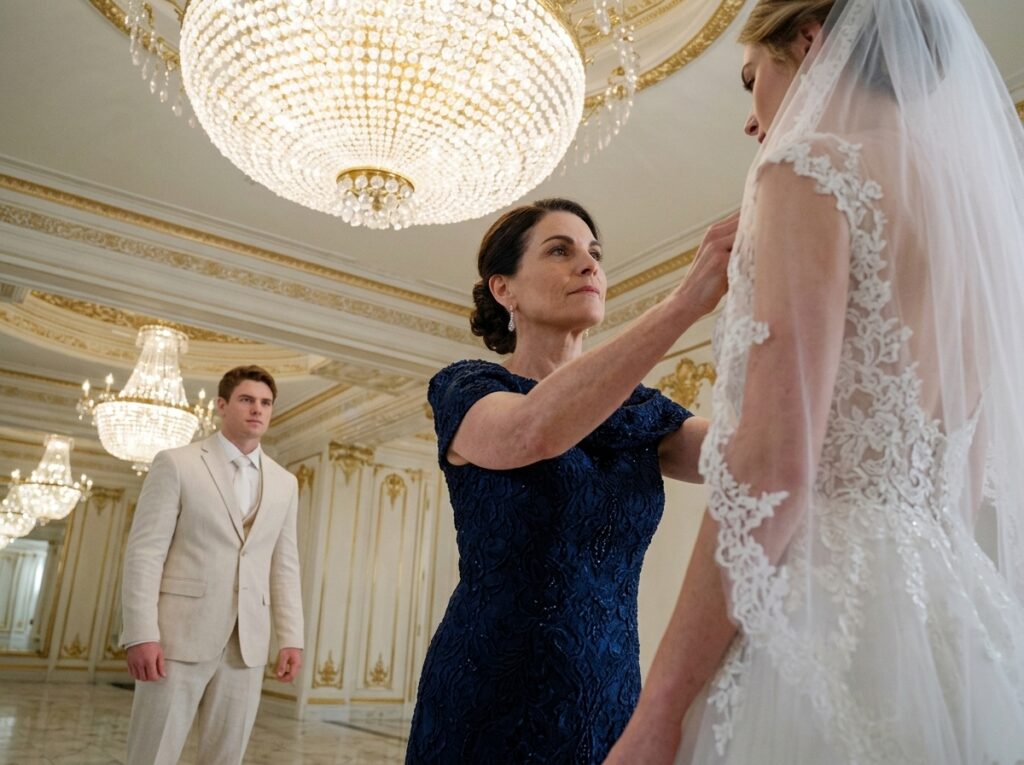
She tried to humiliate the bride in the cold marble corridor of a mansion that smelled like money and rot — and the bride smiled like someone who had already read the ending of the mother’s story.
The wedding hallway on the second floor of the Vance estate was not beautiful in the way postcards are beautiful. It was the kind of cold, architectural cruelty that reveals itself only when you stand still long enough to hear the silence humming between the columns — a silence that had been manufactured, polished, and maintained by a woman who believed that quiet was a weapon she alone knew how to sharpen. The air carried the suffocating sweetness of imported lilies — thousands of them, arranged in crystal vases every four feet along the corridor, their petals already browning at the edges because no one had replaced them since the morning. This was how the Vance family did things. Appearances held in place long after the substance had decayed.
Elena stood near the ornate window at the far end of the hall, adjusting the intricate lace at her shoulder with fingers that did not tremble. Her gown was ivory, cut close to her body in a way that made her look smaller than she was, more fragile than she had ever been. She had spent two years learning how to look like a woman who did not belong in rooms like this — and in those two years, she had become remarkably good at it.
She was waiting for the music. That was all. The strings would begin in the ballroom below, a signal for the procession to start, and in eight minutes she would walk down a staircase lined with two hundred and forty guests who had never once met her mother — who had never seen her photograph — and who would assume, based on the navy gown worn by the woman approaching her now, that Elena Vance was a concession. A temporary arrangement. A mistake the family would eventually correct.
“You look pathetic.”
The voice arrived before Beatrice did — low, deliberate, shaped with the patience of a woman who had spent decades perfecting the exact tone that made people shrink.
Elena turned. Beatrice stood near the cracked antique mirror on the wall — that mirror Elena had been staring into for eleven minutes, watching her own reflection multiply and fracture in the damaged glass. Beatrice wore a designer navy gown that had cost more than the average American household earned in a single year, and her silver hair was pulled back so tightly that the skin at her temples looked stretched over wire.
“You will never be one of us, Elena.” Beatrice took a step closer. Her heels struck the marble with the precision of a gavel. “You think a veil and a diamond ring make you a Vance? You are a commoner. An interloper. A placeholder until Julian finds someone with actual weight.” She paused, letting the word land. “Once the vows are spoken, I will make sure you are kept in the guest wing — invisible and silent. This is not a negotiation. This is how it has always worked in this family.”
Elena looked at her.
She did not step back. She did not cross her arms or lower her chin or perform any of the small, unconscious gestures that Beatrice had trained her to expect. The bride simply stood there, in the pale afternoon light filtering through the window behind her, and the expression on her face was not anger — it was not hurt, not fear, not even the polite endurance that Elena had worn like armor for the last two years.
It was recognition.
Beatrice noticed. Something shifted behind her eyes — a flicker of uncertainty she tried to suppress by tilting her chin higher, by pressing her lips together until they whitened at the seams.
“Is that all?” Elena asked. Her voice was steady, almost gentle, the way a doctor speaks before delivering a diagnosis they know the patient hasn’t heard yet.
Beatrice sneered. She turned on her heel, her navy gown sweeping across the marble floor like a flag, and walked toward the staircase — confident, Elena could see, that she had delivered the final blow. Confident that the girl in the lace gown was about to break.
She did not look back.
She did not see Elena’s hand drop to the small black clutch resting on the console table beside the cracked mirror. She did not see the screen light up — a single message, timestamped, bearing a logo from a venture capital firm with offices on the forty-seventh floor of a tower in New York. She did not see Elena’s thumb move across the glass once, twice, the way someone scrolls to the bottom of a document they have read before.
The bride set the phone down. She slid the ring from her finger — the diamond that Beatrice had selected for her, the one she’d called a “compromise” at the dinner table three months earlier — and placed it on the console beside the clutch.
And then she began to walk toward the staircase.
Not to follow her mother-in-law. Not to plead, not to argue, not to beg for a seat at the family table.
She was walking toward the ballroom. Toward the two hundred and forty guests. Toward the moment the music would start.
Because what Elena carried in her other hand — folded once, creased at the edges, its letterhead embossed in gold foil — was a document that Beatrice had not yet seen, and that would change every single thing the woman believed about who owned what.
And then — in front of the entire wedding party, before a single note of music was played — she unfolded it.
Popular Posts
→- 1
- 2
- 3
- 4




Recently Viewed
Stories you read recently will appear here.





