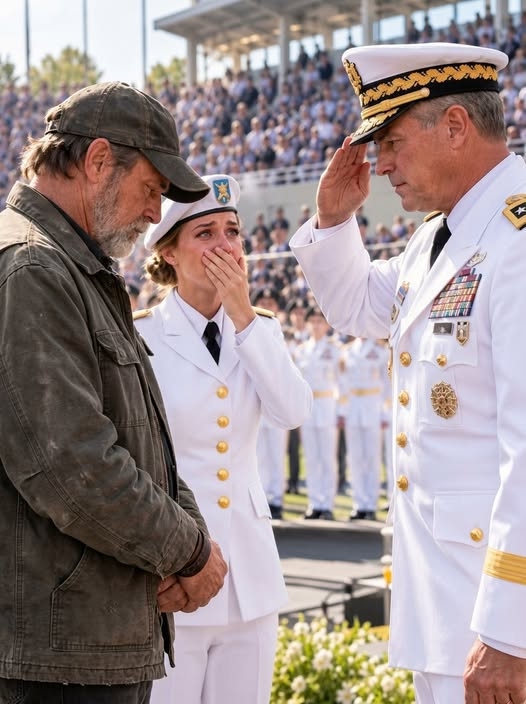
I drove eighteen hours in an aging Freightliner just to watch my daughter become an Army officer.
I expected to sit quietly in the crowd and disappear afterward—but before the ceremony was over, a three-star general saw the battered leather band around my wrist, stopped speaking in front of thousands of people, and walked straight toward me.
My truck rolled into the stadium parking lot shortly after sunrise, rattling so badly my coffee trembled in the cup holder.
When I killed the engine, I sat there for a moment breathing in diesel, old vinyl, and truck-stop soap.
It was 9:18 a.m.
The commissioning ceremony started at ten.
My knee screamed when I climbed down from the cab, but pain had been background noise for years.
I straightened the blue flannel I’d ironed in my sleeper cab and touched the cracked leather band around my right wrist.
To anyone else, it probably looked like junk.
To me, it was a promise.
“Dad!”
I turned and saw Emma running toward me in full dress uniform.
In less than an hour, my little girl would become Second Lieutenant Emma Carter.
“You made it!” she said, wrapping her arms around me.
“Wouldn’t miss it.”
She pulled back, studying my tired face.
“You drove all night, didn’t you?”
I smiled.
“Truck’s still standing.”
Emma rolled her eyes and hooked her arm through mine.
Walking through those polished military families, I noticed the glances.
Expensive watches, pressed suits, perfect dresses—and then me, wearing heavy boots with diesel still buried beneath my fingernails.
I knew that look.
People deciding I wasn’t important.
But I hadn’t come there to impress anybody.
I had come for Emma.
At 10:07, Lieutenant General Daniel Mercer stepped onto the platform.
Three stars gleamed on his uniform as he spoke about sacrifice, leadership, and the hidden cost of service.
I watched Emma standing proudly with her class and remembered her at eight years old, saluting me beside my truck.
I remembered missed school pickups, birthday calls from rest areas, homework finished in diner booths, and every mile I’d driven trying to give her something better.
Then the general stopped speaking.
At first, I thought something was wrong with the microphone.
It wasn’t.
Mercer was staring directly at me.
His expression changed from concentration to confusion—and then something deeper.
Recognition.
His eyes dropped to my wrist.
The stadium slowly fell silent.
Emma glanced toward me, her face tightening with confusion as the general stepped away from the podium.
Then he started walking across the field.
Toward me.
Thousands of people watched.
Phones lowered.
Programs stopped rustling.
Even the officers near the platform seemed unsure what was happening.
My heart began pounding.
Mercer stopped directly in front of me.
Up close, he no longer looked like a decorated commander addressing a commissioning class.
He looked like a man staring into his own past.
His eyes remained fixed on the cracked leather band I had carried through rainstorms, truck stops, hospital waiting rooms, lonely highways, and years I rarely spoke about.
Then all the color drained from his face.
For one endless second, a three-star general stared at an exhausted truck driver as though he’d just seen a dead man standing in front of him.
His hand slowly rose.
He saluted me.
Emma’s mouth fell open.
Hundreds of cadets stared, and suddenly every person who had barely noticed me earlier was trying to understand who I was.
But Mercer didn’t look at them.
He leaned closer, his voice barely above a whisper.
And when he said the words I’d spent years believing I would never hear again, my blood turned cold…
“Carter, we left you on that mountain.”
My lungs forgot how to work.
The stadium disappeared.
For half a second there was no sunlight, no commissioning class, no brass band waiting beside the platform.
There was snow.
Rotor wash.
Gunfire cracking against rock.
A radio screaming through static.
And a twenty-four-year-old Daniel Mercer grabbing my vest while I shoved him toward the last helicopter.
I blinked.
The stadium came rushing back.
Mercer’s salute was still raised.
“Sir,” I whispered.
His eyes shone.
“Jesus Christ.”
His hand dropped.
“You’re alive.”
I could feel Emma staring at me.
So could he.
Mercer looked toward her, then back at me.
“That’s your daughter?”
I swallowed.
“Yes.”
He looked at Emma again.
Something in his face broke open.
The general who had commanded thousands of soldiers suddenly seemed unable to decide where to put his hands.
Emma stepped out of formation before catching herself.
“Dad?”
That single word contained twenty-two years of questions I had worked very hard to keep her from asking.
Mercer heard them too.
He turned toward me.
“You never told her.”
It wasn’t an accusation.
That made it worse.
I looked down at the leather band.
“No.”
“Why?”
“Not here.”
Mercer followed my eyes toward the thousands of people watching us.
He nodded.
Then, without another question, he turned and walked back toward the podium.
The stadium remained silent.
Mercer stood behind the microphone.
For several seconds he said nothing.
Then he looked toward the commissioning class.
“I owe you an explanation for the interruption.”
My stomach tightened.
“General—”
He heard me.
He didn’t stop.
“There are moments in a soldier’s life when the past does not ask permission before walking back through the door.”
He glanced toward me.
“I have just experienced one.”
Emma’s eyes never left my face.
Mercer continued.
“The gentleman in the audience is here as a father today.
I will respect that.”
Relief loosened something in my chest.
“He has not given me permission to tell his story.”
A pause.
“And rank does not give me the right to take that choice from him.”
Then Mercer looked at the new officers.
“But remember what you just witnessed.
Never assume you know the measure of a person from his clothes, his job, his scars, or the seat he occupies in a crowd.”
His voice steadied.
Popular Posts
→- 1
- 2
- 3
- 4




Recently Viewed
Stories you read recently will appear here.





