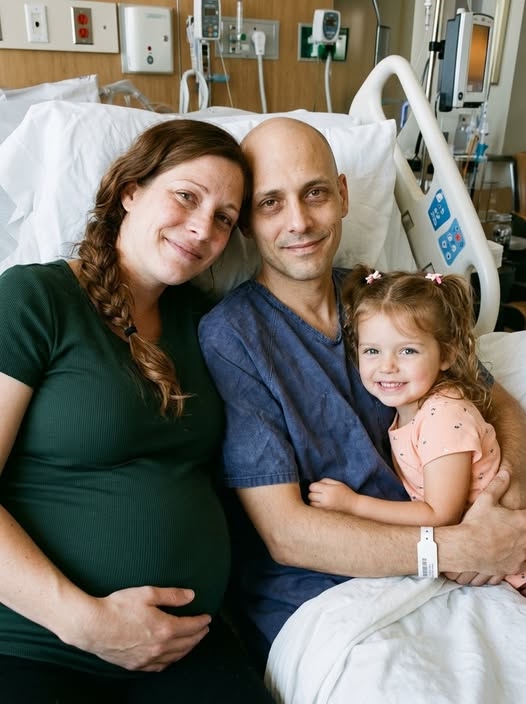
For eight months, my entire life had become a collection of lists. Medication schedules. Oncology visits. Insurance calls. Bills. Lucy’s preschool calendar. My prenatal appointments.
One evening, Jack watched me organizing pills at the kitchen table. “You know you don’t have to control every minute of every day, right?”
I looked up at him. “I’m six months pregnant, Lucy is four, and my husband has cancer. Which part of that situation would you like me to stop managing?”
He smiled weakly. “Maybe start with me.” “You’re the least trustworthy part.” “We’ve been together since high school.” “Exactly. I have years of evidence.”
He laughed, but it immediately dissolved into a coughing fit so severe he had to grip the edge of the table. That was how we survived those months: I organized everything, Jack made jokes, and neither of us said the thing echoing in the silent spaces between us—that he might not survive.
During the final months of his illness, Jack began to disappear. Not constantly, but enough to trigger my suspicion. “Where were you?” I asked one afternoon. “Out.” “For three hours?” “I needed air.” “You can barely make it across the room.” “I’m fine.” “What’s in your jacket?” “Nothing.” “Those are papers.”
He gave me that familiar look, the one he used whenever he knew an interrogation was inevitable. “Claire.” “And you were on your laptop at two in the morning.”
He leaned forward, pressing a soft kiss to my forehead. “Please don’t interrogate the dying man.” “I hate when you joke like that.” “I know.”
I looked down at the papers sticking out of his coat pocket. “Whatever you’re doing, you can tell me.”
His expression shifted into something heavy and melancholic. “I wish I could.” “Then tell me.” He glanced away. “You already have enough to carry.” “That’s not your decision.” “Sometimes it should be.” “What does that even mean?”
He studied me for a long moment. “If someone showed up tomorrow and needed help, you’d say yes before asking whether you could afford it.” “That sounds like a compliment.” “It scares me.” “Why?” “Because you never know when to let somebody else be the problem.”
At the time, I thought he deserved one part of his life where cancer—and I—weren’t constantly watching him. So I stopped asking. After he died, that became one of my deepest regrets.
Five weeks later, Jack’s condition deteriorated quickly. Near the end, I sat beside him, holding his frail hand. “You look scared,” he whispered. “So do you.” “I’m allowed.” “So am I.”
He managed a weak, fleeting smile. “You’ll be okay.” “Don’t say that.” “You will.” “No, Jack.” “Promise me you’ll keep going.” “I don’t know how.” “You’ll figure it out.” He squeezed my fingers with what little strength he had left. “You always do.”
Those were the last clear words he ever spoke to me.
Three days after his death, I sat at our kitchen table staring at a funeral invoice and two overdue notices. A bank representative spoke carefully over the phone. “There isn’t enough remaining to cover next month.” “I know.” “And the loan against the house…” “I know about the loan.” “Do you have other savings?” “We used them.” “Anything you could sell?” “I already sold my jewelry.” “I’m sorry.” “So am I.”
She hesitated. “Was all of this for your husband’s treatment?” “Yes.” “And you borrowed against the house?” “When somebody tells you there is one more treatment that might help, you don’t stop to ask whether you can afford hope.”
She went quiet. That was the cruelest part of illness: hope eventually dies, but the bills never do.
A week after the funeral, I returned to the hospital to collect Jack’s belongings. A nurse named Rachel handed me a plastic bag. “I’m so sorry, Claire.” “Thank you.”
Inside were his watch, phone charger, toiletries, a paperback book, and a gray women’s cardigan. I pulled the sweater out, frowning. “This isn’t mine.”
Rachel looked at it, blinking. “Oh. I thought it belonged to the woman who visited him.”
I froze. “What woman?”
Her face changed instantly. “I assumed she was family.” “Jack didn’t have family.” “I’m sorry.” “How often was she here?” “Several times.” “How long did she stay?” “Sometimes a few hours.” “What did she look like?” “Dark hair. Early forties.”
My stomach tightened into a knot. “Did they argue?” “Not that I saw.” “What were they doing?” “Mostly talking.” She hesitated. “There were usually papers spread around.”
Papers. The word echoed in my mind, instantly bringing back the documents hidden in Jack’s jacket. “Can I see the security footage?” “I can’t just show you hospital surveillance.” “Then tell me who she was.” “I honestly don’t know.”
After multiple insistent conversations with the hospital staff, I finally gained access to hallway surveillance footage. The moment I saw the woman on the screen, I knew I had never laid eyes on her before. She walked into Jack’s room carrying a folder. “How long was she in there?” I asked. “Almost two hours.” “And this recording from the next day?” “She’s crying,” Rachel murmured. “Were they alone?” Rachel hesitated. “Claire…” “Were they?” “Most of the time.”
For three days, I replayed everything in my mind: the unexplained trips, the late-night laptop sessions, the hidden papers, and the mysterious woman crying beside my dying husband’s bed. At two in the morning, lying alone in our dark bedroom, I whispered into the empty space, “Were you cheating on me?”
I hated myself even as the words left my lips.
The next afternoon, someone knocked on our front door. Lucy was sitting on the living room floor, coloring in a book. “Mommy, who is it?” “I don’t know, sweetheart.”
I opened the door, and my breath caught. It was her—the woman from the hospital footage. She held a sealed envelope tightly against her chest. “Are you Claire?” she asked, her voice strained. “Who are you?” “My name is Mara.” “Why were you visiting my husband?” “Jack asked me to bring you this.” She extended the envelope toward me. “That wasn’t my answer.” “I know.” Her expression softened with deep sorrow. “He told me to give it to you only after he died. Not before.” “What is it?”
Popular Posts
→- 1
- 2
- 3
- 4




Recently Viewed
Stories you read recently will appear here.





