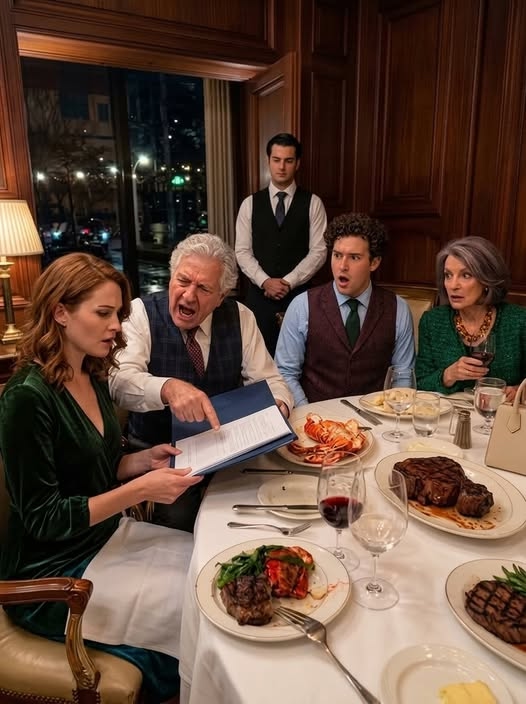
Her Father Demanded 15 Million Until Her Blue Folder Changed Everything
Olivia Collins was not late because of traffic.
She was late because she had spent five years learning the difference between disrespect and self-respect, and she wanted to feel the difference in her body one more time before she walked through that door.
At 7:05 in the evening she stood outside the private dining room of the country club and listened to the rain tap against the tall windows. It was a soft rain, the kind that came at the tail end of a storm when the sky had already spent its anger and was only tidying up afterward. Inside, silverware clicked against china. Someone laughed too loudly. Her brother Ethan was laughing through a mouthful of wine, the careless laugh she had heard her whole life, the one that arrived whenever he knew someone else would clean up whatever he had knocked over.
“She thinks she’s special now just because she got lucky with some hotels,” Ethan said.
Olivia did not move. She had learned, over many years, not to trust the first instinct. The first instinct was to open the door and defend herself, to prove that nothing about the last decade had been luck. But defending yourself to people who benefit from misunderstanding you is a game with no exit, and she had stopped playing it long ago.
Then her father’s voice cut through the room, and even through the door she could hear the specific weight he put on the words so that they would land.
“Where is she? It’s 7:05. Disrespectful.”
The word landed against her chest, but it did not enter the way it used to. That was the thing she had come to feel. Five years earlier it would have gone straight through her like a key into a lock she had spent her whole childhood keeping oiled and ready. Five years earlier she would have already been apologizing before she reached the table, already folding herself smaller to make room for his displeasure.
Five years earlier she had stood in a church hallway in a white dress, holding her phone so tightly her knuckles ached.
Her mother had been fixing a pearl pin in her hair, murmuring something about the photographer. Somewhere beyond the closed doors, Daniel was waiting at the front of the church in a gray suit he had bought secondhand and pressed himself the night before, because they had been saving every dollar for the down payment on a life. The only thing missing had been her father, and she had told herself, standing there, that he would come. He was always late to things that mattered to other people. He would come.
And then Richard Collins, her father, sent one text.
Can’t make it. Important meeting.
That was all. No phone call. No rushed apology. No explanation that sounded like it had come from a human being with a heart. Just seven words, sent the way you might cancel a dentist appointment.
She had read it three times. Then she had put the phone down on a windowsill, and she had walked down the aisle alone while an empty wooden chair in the front row said everything the Collins family would never say out loud. Her father had not missed traffic. He had not been trapped in a hospital or stranded on a runway. He had made a choice,, and now, finally, she was about to find out.
In the Collins family, the way you handled a wound was to agree that it had never bled.
Then, one gray afternoon almost a year later, a blender had arrived at her apartment in the mail with no card and no note. It was a good blender, expensive, the kind of thing you registered for at a wedding and then forgot about. She had sat down on the kitchen floor beside the open box and had not been able to get up, because the blender reminded her of everything the wedding was supposed to have been, and everything it had not been.
Daniel had found her there. He had come home from work and set down his bag and found his wife sitting on the kitchen floor beside a cardboard box, and he had understood immediately, the way he always understood, that this was not about a blender.
He did not tell her to be grateful. He did not say fathers were complicated, or that she should call and clear the air, or that holding on to things only hurt her. He did not offer any of the small useless sentences people reach for when someone else’s pain makes them uncomfortable. He simply opened a cabinet, put the blender away on a high shelf where she would not have to look at it, and then he sat down beside her on the cold tile floor and stayed there until she could breathe again.
That was Daniel’s love language. He stayed. He built. He noticed what silence did to her and refused to use it as a weapon. In a family that communicated through absence and expected her to be fluent in it, he was the first person who had ever simply been present.
They did not have money in those years. What they had was work, and each other, and a stubborn belief that the two might add up to something.
Popular Posts
→- 1
- 2
- 3
- 4




Recently Viewed
Stories you read recently will appear here.





