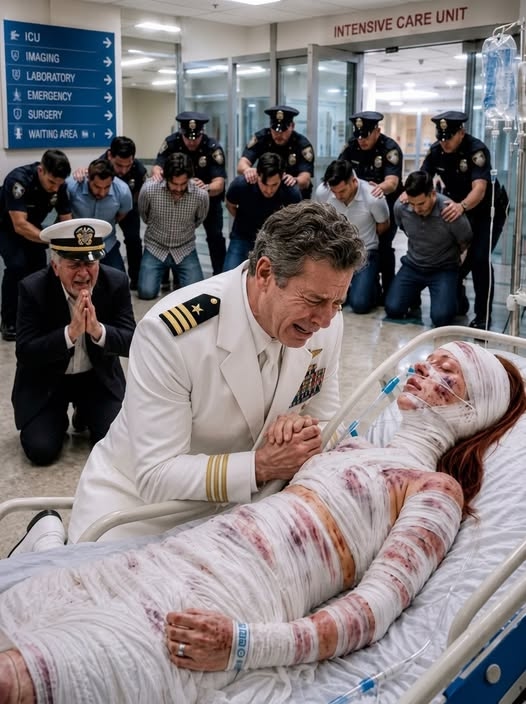
Nine members of my wife’s family put her in the ICU, cost us the daughter we had already named, and then sat beneath fluorescent hospital lights telling anyone who would listen that nobody had touched her.
When I walked into the trauma-family lounge in uniform, Clara’s father looked at the silver eagle on my chest and smiled.
Not because his daughter had survived emergency surgery.
Not because his unborn granddaughter had died.
Because Everett Hale believed grief would make me stupid.
He leaned back in his chair while eight grown sons occupied almost every seat around him.
“Go ahead, Colonel,” he said loudly enough for the nurses at the desk to hear. “Call your soldiers.”
Grant, the oldest, gave a nervous laugh.
Mason stared at the floor.
Eli, the youngest, looked like he might be sick.
Everett spread both hands.
“Bring a convoy. Have us all dragged out. Then we can explain in court exactly what kind of man Clara married.”
Three minutes earlier, an obstetrician had told me our daughter was dead.
Mara.
Twenty-three weeks.
Clara had named her before we were certain we were having a girl.
There was a tiny yellow sweater folded in our dresser at home because Clara had bought it absurdly early.
When I told her the baby would not fit into it for months, she had laughed.
“She’ll grow into it.”
Now Mara would never grow into anything.
Everett wanted me angry enough to forget that.
I looked at him.
Then I took out my phone.
His smile widened.
“There it is.”
I made one call.
My commanding officer answered on the second ring.
“Sir, my wife has been seriously injured in a civilian incident. We lost our unborn child. I’m requesting emergency leave.”
Nobody in the room laughed now.
I kept my eyes on Everett.
“I also need it documented that no personnel from my command are to involve themselves in the civilian investigation unless requested through proper channels.”
Everett’s expression changed.
Only slightly.
But I saw it.
I ended the call.
“That’s it?” he asked.
“That’s it.”
“You’re not going to threaten me?”
“No.”
His jaw tightened.
“You always were too careful.”
“No, Everett.”
I slipped the phone into my pocket.
“You were counting on me not being careful.”
Grant stopped smiling.
That was the first thing Everett lost that night.
Not his freedom.
Not his family.
His plan.
At 12:17 a.m., I had been inside the hospital for eleven minutes.
The trauma surgeon had taken me into a private consultation room before I saw Everett.
An obstetrician joined him.
Both sat.
I remained standing because sitting felt impossible.
“Colonel Mercer,” the surgeon said, “your wife survived surgery.”
Survived.
Nobody used that word when everything had been close to fine.
“What injuries?”
“Three fractured ribs. A fractured collarbone. Significant abdominal trauma and internal bleeding.”
The obstetrician spoke next.
“There was a placental abruption.”
My hands went cold.
Clara had texted me a photograph that morning of the side of her stomach.
Mara had kicked hard enough to make a small bump beneath the skin.
Clara’s caption had said, Your daughter is already demanding more room.
Now the doctor was looking at me with the expression people used when there were no useful words left.
“I’m sorry,” she said. “We couldn’t save the baby.”
For several seconds, the room disappeared.
I saw the half-painted nursery.
A crib still inside its box.
Clara standing barefoot in our kitchen with one hand under her stomach.
Me kneeling beside her because Mara always seemed to move when I spoke.
I put one hand on the back of a chair.
“Was Clara conscious when she arrived?”
“Intermittently.”
“Did she say what happened?”
“Not clearly enough for a full statement.”
The surgeon paused.
“The paramedics reported nine adult male relatives at the residence.”
Nine.
Everett.
And Clara’s eight brothers.
I already knew why she had gone there.
Eli had called that afternoon.
He wanted to leave Hale Industrial, the family company Everett treated as both a business and a leash.
Clara had told me about the call while fastening an earring.
“He wants out.”
“Do you want me to come with you?”
She shook her head immediately.
“No.”
“Clara—”
“If you walk into Dad’s house wearing a uniform, he’ll make you the story.”
Then she smiled.
“I’m his daughter. I know how to handle him.”
I kissed her forehead.
That was the last time I touched her before someone hurt her.
Back in the trauma lounge, two local detectives entered.
One spoke quietly with hospital security.
Then the older detective faced the Hale family.
“We’ll need to speak with each of you separately.”
Everett stood.
“We already gave officers a statement at the house.”
“You’ll each give individual statements now.”
“My sons are exhausted.”
The detective looked at him.
“So is your daughter.”
Silence.
Everett’s face remained calm.
His sons’ faces did not.
Grant was taken first.
Mason second.
Then Cole.
Peter.
Daniel.
The others followed.
Eli was last.
As he passed me, he stopped.
His eyes were red.
“I’m sorry.”
I wanted to grab him.
I wanted to ask what he had done.
What all of them had done.
Instead, I stepped aside.
“Tell the police why.”
His face collapsed.
Then the interview-room door shut behind him.
The family that had entered the hospital as one unit was now behind nine different doors.
Twenty minutes later, I was standing outside the surgical unit when Peter stepped out of an elevator carrying a plain white envelope.
He approached the trauma surgeon.
“Doctor?”
The surgeon turned.
“This is Clara’s medical history.”
I looked at Peter.
Clara’s medical records were already available inside the hospital system.
Peter did not know the name of her obstetrician until that night.
The surgeon accepted the envelope.
“Thank you.”
Peter glanced at me once.
Then walked away.
The surgeon did not open it.
He handed it directly to a hospital administrator standing beside a security officer.
“What is it?” I asked.
The surgeon hesitated.
Popular Posts
→- 1
- 2
- 3
- 4




Recently Viewed
Stories you read recently will appear here.





