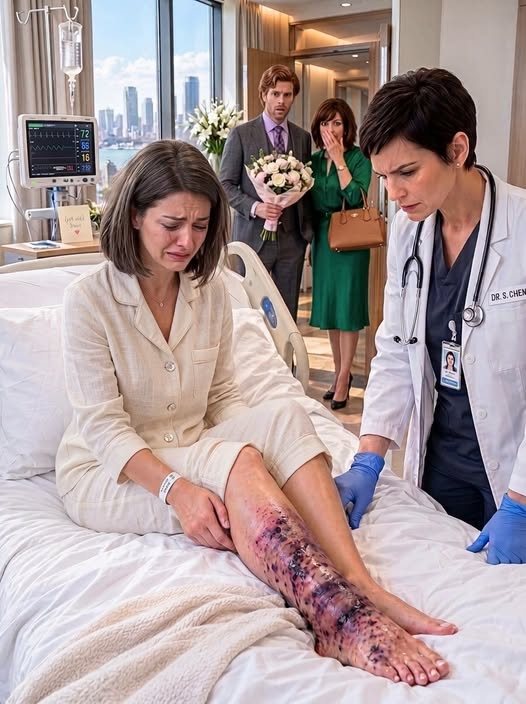
canceled it and sneered, “You’ll embarrass me stumbling around like a lunatic. Go back to bed,” warning that he would freeze my cards if I tried to leave. I locked myself in the bathroom, slipped out through the fire stairs, and made it to the hospital alone. The instant the doctor examined my ankle, her face changed. She turned sharply to the nurse and said, “Call the police! Right now!”
A 104-degree fever had pushed my body past its limit. I lay tangled in sweat-soaked sheets, trembling so violently that every muscle ached and my teeth struck together until my jaw hurt.
“I need to go to the emergency room,” I whispered.
My husband, Tristan, stood in the doorway of his home office, his face washed in the pale glow of two computer screens. Instead of looking worried, he sighed like I was an inconvenience he was too tired to deal with.
“You’re not in immediate danger, Reese. If we leave now, we’ll spend six hours sitting in the waiting room. We can handle this tomorrow.”
I stopped trying to convince him. With shaking hands, I peeled away the medical tape covering the small scrape on my heel, and the sight underneath made my breath catch.
The skin surrounding the injury had turned a disturbing shade of deep purple, spreading well beyond the original wound. Dark streaks climbed around my ankle and into my calf, while the swollen area felt unnaturally hot beneath skin stretched painfully tight.
Even through the haze of fever, one realization cut through clearly. If I stayed in that bed waiting for Tristan to decide whether I was sick enough to deserve help, I might not make it through the night.
I limped into the hallway, opened a ride-share app, and booked a car to the hospital. Three minutes later, my phone chimed with a notification: Your ride has been canceled.
Tristan appeared behind me holding his own phone, his expression filled with irritation.
“You are not going to the hospital in pajamas at midnight. You’ll humiliate both of us staggering through the lobby like some lunatic. Try ordering another car and I’ll freeze the card. Go back to bed. Now.”
A chill that had nothing to do with the fever ran through me. I pushed past him, locked myself inside the guest bathroom, and moments later heard his fist slam against the door.
My hands were barely steady enough to work, but I disconnected access to our joint payment account and downloaded another transportation app. I ordered a second ride, slipped out through the fire stairs, and escaped before Tristan realized what I was doing.
By the time I reached the hospital, I could hardly put weight on my leg. A triage nurse took one look at me and immediately rushed me into an emergency treatment bay.
Minutes later, Dr. Mensah entered, pulled on a pair of gloves, and carefully removed the temporary bandage around my ankle. She examined the injury for only a few seconds before her entire expression changed.
She turned toward the nurse without hesitation.
“Call the police. Right now.”
A rushing noise filled my ears.
“Police?”
Dr. Mensah placed both hands firmly on my shoulders and looked directly into my eyes.
“Reese, stay with me. Stay calm. You’re safe here.”
More doctors hurried into the room as medications were prepared and the edges of my vision began to blur. Voices overlapped around me while the sedative slowly dragged me toward unconsciousness.
But one question remained sharp even as everything else faded.
Why had the doctor called the police? And why had my husband been so determined to keep me from reaching the hospital?

The last thing I remembered was Dr. Mensah telling someone to start another IV.
Then everything went black.
When I opened my eyes again, the first thing I heard was a monitor beeping beside my bed.
Slow.
Steady.
Alive.
For several seconds, I had no idea where I was.
Then the pain returned.
A deep, burning pain traveled from my ankle all the way up my leg.
I tried to move.
A nurse immediately appeared beside me.
“Don’t.”
Her voice was gentle but firm.
“You’re in Mercy General. You had surgery.”
“Surgery?”
My throat felt like sandpaper.
“What happened?”
She checked my monitor before looking at me.
“You had a severe bacterial infection in your leg. It had already entered your bloodstream.”
My stomach dropped.
“Sepsis?”
She nodded.
“You were very sick when you arrived.”
I closed my eyes.
Tristan had told me I was embarrassing him.
He had told me to go back to bed.
He had threatened to freeze my cards.
And while I was fighting to stay conscious, he had been sitting in his office telling me I wasn’t in immediate danger.
“What did they find?” I whispered.
The nurse hesitated.
“What do you mean?”
“Why did Dr. Mensah call the police?”
The room suddenly became very quiet.
The nurse looked toward the door.
Then back at me.
“I think you should ask her yourself.”
Before I could answer, the door opened.
Dr. Mensah walked in.
She wasn’t smiling.
She carried a tablet in one hand and a clear evidence bag in the other.
Inside the bag was the medical tape I had removed from my ankle at home.
I stared at it.
“Why do you have that?”
“Because the wound you came in with doesn’t look like an ordinary scrape.”
My heart began pounding.
“What does it look like?”
She pulled a chair beside my bed.
“It looks like someone deliberately caused a chemical injury and then allowed it to become infected.”
I stared at her.
“No.”
She nodded slowly.
“We found traces of a corrosive substance around the original wound.”
I couldn’t breathe.
“But I fell.”
“When?”
“Three days ago.”
“Where?”
“In the kitchen.”
“Did anyone help you?”
“My husband.”
Dr. Mensah’s expression tightened.
“What exactly happened?”
I swallowed.
“I dropped a glass. I stepped on a piece of it. Tristan cleaned it.”
Popular Posts
→- 1
- 2
- 3
- 4




Recently Viewed
Stories you read recently will appear here.





